
Check who regulates a casino before you play
 Available in US

A licence applies under its issuing regulator’s rules and does not by itself show that a casino may serve customers in Great Britain.
What a Casino Licence Does—and Which Regulator It Answers To
A casino licence identifies the authority under which an operator is permitted to run gambling services. It also identifies the regulator responsible for overseeing that operator within the scope of its rules. The important point is that a licence is not a general certificate that applies everywhere: its meaning depends on who issued it and which market the operator is serving.
For an online casino, the licence belongs to the operator’s regulatory arrangement, not to the phrase “licensed” in isolation. A site may describe itself as licensed, but that statement alone does not establish which regulator is responsible or whether the operator is authorised to serve customers in Great Britain. To understand what a casino licence means, you need to identify the regulator behind it and the market the operator is targeting.
In Great Britain, operators serving customers must hold a licence from the UK Gambling Commission, regardless of where the business is based. The location of a company’s headquarters does not replace this requirement. A company operating from outside the country still needs the relevant UK Gambling Commission licence if it serves customers in Great Britain.
If you’re considering a casino that may not hold a UK licence, check its licensing and terms carefully before signing up. This list gives you one practical detail to consider: the stated payout speed.
-
SlotoSport
- Payout speed
- 1-3 business days
SlotoSport has a stated payout speed of 1–3 business days, which gives you a timeframe to consider when reviewing its terms.
-
SpinFormula
- Payout speed
- 1-3 business days
SpinFormula lists a payout speed of 1–3 business days. You can use this as one point of reference when assessing its payment terms.
-
Chanze
- Payout speed
- 1-3 business days
Chanze’s stated payout speed is 1–3 business days. Check the casino’s terms to understand how this timeframe applies.
-
NightLuck
- Payout speed
- 1-3 business days
NightLuck lists payouts as taking 1–3 business days. You may want to review its terms for details about the payout process.
-
Zombillion
- Payout speed
- 1-3 business days
Zombillion has a stated payout speed of 1–3 business days. Consider this timeframe alongside the casino’s other terms.
-
NightWin
- Payout speed
- 1-3 business days
NightWin lists a payout speed of 1–3 business days. You can check its terms for further information about withdrawals.
-
Revery Play
- Payout speed
- 1-3 business days
Revery Play’s stated payout speed is 1–3 business days. Review its terms to see how the timeframe relates to its payout process.
-
Jetsetspins
- Payout speed
- 1-3 business days
Jetsetspins lists payouts as taking 1–3 business days. You can factor this stated timeframe into your assessment of its terms.
-
EvoSpin
- Payout speed
- 1-3 business days
EvoSpin has a stated payout speed of 1–3 business days. Check its terms for any additional details about payouts.
-
Britsino
- Payout speed
- 1-3 business days
Britsino lists a payout speed of 1–3 business days. You may wish to review its terms for more information about withdrawals.
That creates a distinction between a UK Gambling Commission licence and a licence issued by another regulator. A non-UK-regulated casino operates without oversight from the UK Gambling Commission. It may have a licence from a different jurisdiction, but that does not turn the licence into a UK Gambling Commission authorisation. The two regulators are separate authorities, and one does not act on behalf of the other.
You can think of a licence as answering two related questions: which authority oversees the operator, and within what regulatory framework? It does not, by itself, answer every question a customer might have about the operator’s conduct or the services available to them. Nor does the word “licensed” mean that every regulator offers the same rules, supervision or routes for dealing with concerns. Those details depend on the authority named in the licence and the scope of its oversight.
This distinction matters when a site uses broad wording such as “internationally licensed” or “regulated online casino”. Those descriptions may refer to an authority outside the UK. They do not establish that the operator holds a UK casino licence or is overseen by the UK Gambling Commission. If a site serves customers in Great Britain, its base of operation does not remove the UK licensing requirement.
 Non-UK Casinos: Licences and UK Player SearchesThe page groups searches for foreign and offshore casinos for UK players, including Anjouan, Curaçao and Gibraltar licences and GamStop listings.
 Foreign casinos for UK players: licensing and rulesLearn how UKGC permission differs from offshore licensing, what UK law means for access, and how bonuses, withdrawals and GamStop work.
A useful way to read a licence claim is to separate the claim into parts. First, identify the named operator rather than relying only on the casino’s brand. Second, identify the regulator said to have issued the licence. Third, establish whether the claim is about authorisation in the regulator’s own jurisdiction or about permission to serve customers in Great Britain. These are different questions; an answer to one does not automatically answer the others.
The same distinction applies when comparing licensed online casinos. Two operators may both describe themselves as licensed while answering to different regulators. That shared label does not make their licences interchangeable. The regulator’s authority defines the relevant oversight framework; the word “licensed” alone does not tell you that the UK Gambling Commission is involved.
A new licensed online casino is not an exception to this principle. Being new does not change which regulator it answers to, and a licence from outside the UK does not become a UK licence because the site is recently launched or presents itself to British customers. The relevant issue is still the operator’s authorisation for the market it serves.
When you see a reference to a casino licence UK players may encounter, avoid treating “licence” as a single universal status. Ask which authority issued it and whether the operator holds the UK Gambling Commission licence required to serve customers in Great Britain. That keeps the central distinction clear: a non-UK regulator may oversee an operator under its own framework, while the UK Gambling Commission is the regulator responsible for licensing operators serving the Great Britain market.
How Malta and Other Offshore Licensing Jurisdictions Fit In
A casino’s licence is issued within a particular regulatory system. The issuing jurisdiction tells you which authority’s rules the operator claims to follow; it does not, by itself, tell you that the casino is authorised to serve customers in every country. That distinction matters when you see a Malta, Curaçao, Gibraltar or Anjouan licence mentioned on a casino website.
These jurisdictions appear in the non-UK licensing landscape, but their names are not interchangeable labels for one common licence. Each points to a different regulator and framework. A Malta-licensed online casino, for instance, is not thereby licensed by Curaçao or Gibraltar. Nor does a licence from any of these jurisdictions become a UK Gambling Commission licence simply because the casino accepts a particular payment method or displays a UK-facing website.
The practical question is therefore not only, “Is there a licence?” It is also, “Which authority issued it, and what does that authorisation cover?” The regulator’s identity sets the starting point for understanding the operator’s oversight. The licence’s scope determines what activity and markets it is intended to cover. A jurisdiction name alone cannot answer both questions.
Why the jurisdiction label is not enough
Casino websites may place a regulator’s name or logo in a footer, terms page or registration screen. Treat that as a claim to verify, not as a complete explanation. The wording may identify the claimed licensing jurisdiction without showing whether the authorisation applies to the particular company operating the site or to the service presented to you.
 Non-UK-Registered Casinos: How Regulation WorksLearn how non-UK oversight differs from UKGC regulation, and what to check in licensing claims, GamStop access, payments and bonus terms.
 Casino sites not registered with GamStop in the UKLearn how GamStop’s UKGC-based coverage works and what to check on overseas casinos, from licensing and payment claims to withdrawal terms.
This is why “licensed” needs a qualifier. “Licensed in Malta” describes a claimed relationship with one jurisdiction; it does not mean “licensed in the UK”. The same distinction applies to casinos describing themselves as licensed in Curaçao, Gibraltar or Anjouan. A foreign licence can indicate oversight by its issuing authority, but it cannot substitute for authorisation required under another jurisdiction’s rules.
The four names also should not be used to infer identical protections. A licence from one regulator does not establish that another regulator requires the same controls, complaint routes or safeguards. Those details depend on the relevant framework and the operator’s actual authorisation. Comparing the jurisdictions responsibly means identifying them separately rather than treating “offshore licence” as a single standard.
Reading a licence claim in context
Start by locating the operator’s own licensing statement and identifying the named authority. Then consider which legal company the statement concerns and whether the licence is presented as covering the casino service you are viewing. If the site uses more than one company name, do not assume that a licence shown for one entity automatically applies to every related brand or service.
A Malta licence and an Anjouan licence, for example, are not two ways of naming the same approval. They point to different regulatory settings. The same is true of Curaçao and Gibraltar. The label is useful because it tells you where to direct further checks, but it is not itself a full account of what the regulator supervises or what recourse is available if a dispute arises.
Malta
A licence issued by the Malta Gaming Authority (MGA) within its own regulatory framework.
Curaçao
A jurisdiction common in the non-UK licensing landscape with its own set of rules.
Gibraltar
A regulatory system separate from the UK Gambling Commission and other offshore jurisdictions.
Anjouan
A licensing authority that does not provide the same oversight as UKGC or MGA.
This also explains why a list of jurisdictions cannot answer how many licensed online casinos operate in the UK. The number of casinos associated with foreign regulators is not a count of operators holding the authorisation required for the British market. Those are different categories, even when a site’s marketing uses broad terms such as “licensed casino”.
If you are trying to work out how an online casino is licensed, separate three things: the authority named, the company said to hold the authorisation, and the market the service is intended to serve. Do not merge them into one conclusion. A regulator’s name tells you where the licensing claim originates; it does not, on its own, establish that the operator is authorised for your location or that all regulators provide equivalent oversight.
How to Assess a Casino’s Licence and Player Protections
A licence is only one part of assessing an online casino. You also need to establish which regulator issued it, what protections that regulator requires, and where you can take a complaint if the operator does not resolve it. A site can describe itself as licensed without holding authorisation from the UK Gambling Commission (UKGC), so treat the word as a starting point for checks, not a verdict.
Check who issued the licence
Find the regulator named in the casino’s terms or footer. Then look for the operator’s legal company name and licence details, and check that those details match the regulator’s public records. A mismatch between the company named on the site and the company covered by the licence makes it difficult to know which entity is accountable.
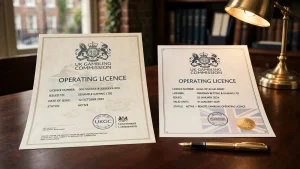 Anjouan Casino Licence in the UK: What It MeansLearn why an Anjouan licence is not UKGC authorisation, and how to assess bonus terms, withdrawals, complaints and cross-border risks.
 Best Offshore Casino Sites: UK Rules and RisksLearn what offshore means under UK rules, why a foreign licence does not authorise service in Great Britain, and what to check…
Do not treat a licence from another jurisdiction as equivalent to UKGC authorisation. Regulators can impose different requirements, and the protections attached to one licence cannot be assumed to apply under another. If the site does not identify its regulator clearly, or the details cannot be checked, you cannot reliably establish what oversight applies.
Compare the protections, not just the label
Look for the controls available to you before depositing: whether you can set limits, take a break or exclude yourself from gambling, and how those choices are applied to your account. Non-UK-regulated casinos may have less stringent responsible-gambling requirements than UKGC-licensed operators. They do not provide the same UK-mandated responsible-gambling tools, such as the protections linked to deposit limits and self-exclusion. A safer-looking logo or a general promise to promote responsible gambling does not show which controls are available or how they work.
Check the privacy information as well. It should explain how the operator handles account and identity data, why information is collected, and how it may be shared. Data-protection rules may be less stringent outside the UKGC framework, so do not assume that a familiar interface means your information is handled under the same requirements.
Map the complaint route before playing
Find the operator’s complaints procedure and read what it says about submitting a complaint, the stages of review, and the regulator or independent service involved if the operator does not resolve the issue. A contact form is not, by itself, an independent dispute route. The key distinction is whether another body can review the disagreement, rather than the casino simply reconsidering its own decision.
Do
- Match the legal company name with the regulator's public records
- Check for available deposit limits and self-exclusion tools
- Map the external complaint route before depositing
Don't
- Treat a non-UK licence as equivalent to UKGC authorisation
- Assume a familiar interface means your data is handled under UK rules
- Rely on a contact form as an independent dispute route
When you use a casino outside the UKGC system, you do not have access to the UK’s Financial Ombudsman Service or the mandatory responsible-gambling tools that apply within the UK framework. Do not assume that a complaint can be escalated to a UK regulator or that a UK dispute service can require the operator to act. If the site’s terms name no external route, that is an important limitation to factor into your decision.
Test the terms against likely problems
Read the rules for account verification, withdrawals, bonus conditions and account closure before you deposit. These terms determine what evidence the operator can request and what conditions apply when you try to withdraw funds. Check whether the wording is clear enough to tell you what could delay or prevent a payout. If a condition is unclear, ask the operator to explain it in writing and keep the response.
A useful comparison is therefore not simply “licensed” versus “unlicensed”. It is a check of the regulator, the specific protections, the handling of personal data, and the route available if a dispute occurs. The best licensed online casino for your needs is not established by a badge or a bonus claim; it is the one whose oversight and terms you can verify and whose limitations you understand before committing money.
What “Licensed Casino” Means for UK Players
The word “licensed” identifies a regulator’s authority over an operator; on its own, it does not tell you which regulator is involved or which market the operator is authorised to serve. A casino may hold a licence issued outside the UK, but that does not make it a UK-licensed casino.

For customers in Great Britain, the relevant distinction is whether the operator holds a licence from the UK Gambling Commission. The operator’s headquarters do not change that requirement: a business based abroad still needs UK Gambling Commission authorisation if it serves customers in Great Britain. A licence from another jurisdiction is not a substitute.
The regulator matters more than the label
When a site describes itself as a licensed online casino, treat that as an incomplete description until you know who issued the licence. “Licensed” could refer to oversight by a regulator outside the UK. It does not, by itself, mean the site is authorised as one of the licensed UK casinos.
This distinction applies whether a casino promotes itself as a Curaçao-licensed or Anjouan-licensed site. Those descriptions identify the stated licensing jurisdiction; they do not establish that the operator holds UK Gambling Commission authorisation. Likewise, the phrase “UK licensed casino” has a specific implication: the operator has the relevant UK licence to serve customers in Great Britain. A foreign licence alone does not support that description.
The practical test is therefore not simply whether a licence is mentioned. You need to distinguish a licence issued abroad from the UK authorisation required for operators serving the British market. If a site’s wording blurs those two things, do not read the broader word “licensed” as confirmation of UK approval.
What a licence does not tell you by itself
A licence label is not a complete description of a casino’s status in every market. It tells you that a regulator is named as the issuer; it does not establish that the operator is authorised to serve customers in Great Britain. Nor does the payment method change the licensing question. A site accepting Litecoin, for instance, does not become a licensed UK casino because it supports that currency. “Licensed Litecoin casino” describes two separate features, not a single kind of UK authorisation.
The same reasoning applies when comparing licensed casino sites that advertise different payment options or use different branding. A payment feature and a licence jurisdiction answer different questions. The former describes how an account may be funded; the latter identifies the regulator associated with the operator. Neither should be used as a substitute for checking whether UK Gambling Commission authorisation applies.
Casino licence requirements depend on the market an operator serves. For Great Britain, the key point is that the requirement follows the customer market, not the company’s physical base. So a foreign location or an overseas licence does not remove the need for UK authorisation when the operator serves customers there.
When you see “licensed casino” in a site description, read it as a starting point, not a verdict. The useful distinction is whether the named licence is from the UK Gambling Commission or from a regulator elsewhere. Only the former answers the question of UK authorisation for an operator serving customers in Great Britain.

The Legal Position of UK Players Using Non-UK Casinos
A non-UK licence does not, by itself, determine whether a player has broken UK law. The Gambling Act 2005 is directed at operators supplying gambling services into the UK market, rather than at individual customers. That distinction matters: an operator’s position under the law and a player’s position are separate questions.
UK law does not expressly prohibit British citizens from using gambling services licensed in another country. It also does not make a player commit a criminal offence simply by gambling on a site that lacks a UK licence. Those points should not be read as approval of a non-UK licensed casino for use in Britain, or as a statement that its operator is authorised to serve customers here.
The relevant legal test for the operator concerns the market it serves, not only where its business is based or which foreign regulator issued its licence. A licence from another country does not replace the authorisation required for operators supplying the British market. Consequently, a site may describe itself as licensed abroad while still operating outside the UK regulatory framework. The operator’s regulatory position does not automatically transfer to the player, but neither does the player’s lack of criminal liability make the service UK-regulated.
This distinction is useful when you encounter terms such as “non-UKGC licensed casino” or “Anjouan licensed casino”. They describe an operator’s claimed or actual regulatory arrangement; they do not establish that the service is authorised in Britain. Likewise, being able to open an account or access a site does not settle the legal question. Practical access and legal authorisation are not the same thing.
The Gambling Act 2005 applies in England, Wales and Scotland, but not Northern Ireland. If you live in Northern Ireland, or are using a service while outside Great Britain, do not assume that the same legal framework applies in the same way. You are responsible for checking the laws relevant to your location and for understanding the implications of using a gambling service licensed elsewhere. Citizenship alone is not a substitute for checking the rules that apply where you are.
Keep three questions separate when assessing your position: whether the operator holds a UK licence for the British market, whether the operator has a licence from another jurisdiction, and whether your own use of the service is prohibited where you are. An affirmative answer to the second question does not answer the first. Nor does the fact that UK law does not make a player’s use of an unlicensed site a criminal offence establish that the site meets UK requirements.
This is why “not a criminal offence for the player” is a narrow statement, not a general assurance about legality, protection or suitability. It describes the treatment of the individual under UK law; it does not convert a non-UK licence into UK authorisation. Before using a non-UK regulated casino, check the rules that apply to you and understand that the operator’s status and your own legal position are distinct.

Curaçao Licences, Crypto Deposits and Payment Routes
A Curaçao-licensed casino may offer several ways to fund an account, but the licence does not determine which payment methods are available. Offshore operators can accept cards, e-wallets, bank transfers or cryptocurrency, sometimes using payment processors other than the providers familiar to UK customers. Availability can therefore depend on the operator, the processor and the terms shown when you make a transaction.
Crypto is one possible route, not a guarantee of simpler payments. A cryptocurrency deposit can bypass the UK ban on gambling funded by credit cards because the payment is made in crypto rather than charged to a credit card. That describes the transaction route; it does not mean the casino is authorised by the UK Gambling Commission or that UK gambling rules no longer matter.
The key distinction is between depositing and withdrawing. A payment option displayed at the cashier may allow you to send funds to the casino without being available for payouts. Before depositing, check the withdrawal terms for the same method: whether it is supported, whether another route must be used, and what conditions apply. Do not assume that a successful deposit proves that you can withdraw through the same channel.
Crypto also adds steps that do not apply in the same way to a card payment. You need to follow the casino’s instructions for the selected currency and network, and check the destination details before sending funds. A transfer sent using the wrong network or to an incorrect address may not reach the account. The casino’s payment terms determine how it credits an accepted deposit and what it permits when you request a withdrawal.
Crypto Deposit Steps
-
1
Check the currency
Follow the casino’s instructions for the selected cryptocurrency.
-
2
Verify the network
Ensure you are using the correct network to avoid losing funds.
-
3
Confirm details
Check the destination address carefully before sending the transfer.
Alternative routes can include e-wallets and bank transfers as well as cards and crypto. A specialist review has also reported deposits charged to a mobile phone bill or taken from a prepaid balance. Treat those as an option reported by that review, not as a standard feature of Curaçao-licensed casinos; check the operator’s current cashier and terms before relying on it.
For any route, read the rules that apply to withdrawals as well as deposits. Non-UK-regulated casinos can have different payment policies, and reports about withdrawal speed do not agree: some describe payouts as taking from 24 hours to five business days, while others warn they can take several weeks. With no regulatory enforcement clock for offshore withdrawals, the stated method alone cannot tell you how quickly money will arrive. A Curaçao licence and a crypto cashier are separate pieces of information; neither establishes that every payment route works in both directions.
What UK Gambling Commission Licensing Changes
For an operator serving customers in Great Britain, a UK Gambling Commission licence is a condition of operating in that market. The requirement does not depend on where the business is based: a company located abroad still needs the relevant authorisation if it supplies gambling services to customers in Great Britain.

This makes a UK Gambling Commission licence more than a label attached to a casino. It identifies the regulator responsible for the operator’s authorisation in the British market. A casino gaming licence issued elsewhere does not substitute for that permission. The distinction matters when you compare a UKGC-authorised casino with a non-UK regulated casino: the latter may hold a licence abroad, but that licence does not give the UK Gambling Commission authority over its operation.
The licence also should not be read as a promise that every transaction will be immediate or every dispute will end in your favour. It establishes which regulator’s framework applies to an operator serving Great Britain; it does not remove the need to read the casino’s terms or understand how its payment process works. A list of UK Gambling Commission licensed online casinos is useful only if each entry is actually authorised for the relevant activity. The word “licensed” on a site, by itself, does not establish that.
Withdrawal timing shows why the regulator behind an operator can matter. Figures reported for non-UK regulated casinos do not agree: one account says withdrawals can be as fast as 24 hours to five business days, while another says they can take as long as three or four weeks. These are conflicting descriptions, not a single reliable timetable. For some offshore withdrawals, there is also no UK regulatory enforcement clock to require the casino to meet a UK-set payout deadline. A stated processing estimate should therefore not be mistaken for a deadline enforced by the UK Gambling Commission.
A UKGC licence does not mean that the regulator processes a withdrawal for you. Its significance is that an operator serving Great Britain is accountable within the UK licensing system. If a casino is based elsewhere, its location does not remove that requirement; if it lacks UKGC authorisation, you should not treat an overseas casino licence as equivalent.
When comparing a casino operating licence with another jurisdiction’s authorisation, start with the market the operator claims to serve and the regulator that issued its permission. The key distinction is not simply where the company is registered. It is whether the operator holds the licence required for customers in Great Britain, and which regulator has authority over its operation.
What an MGA Licence Tells You—and What It Does Not
An MGA-licensed casino is a gambling site that says it operates under a licence issued by the Malta Gaming Authority (MGA). That identifies the regulator named in the operator’s licensing claim. It does not, by itself, establish that the casino is authorised to serve customers in Great Britain.
The distinction matters because a regulator’s authority is tied to its own licensing system. Malta is one of several jurisdictions associated with non-UK-regulated casinos; others include Curaçao, Gibraltar and Anjouan. These jurisdictions are not interchangeable, and a Malta licence should not be described as a UK Gambling Commission licence.
For operators serving customers in Great Britain, the relevant authorisation is a UK Gambling Commission licence, regardless of where the company is based. An MGA licence therefore cannot be used as a substitute for that requirement. If a site presents its Malta status as evidence of UK approval, the two claims are being conflated.

The word “licensed” also needs a precise object. A casino may be licensed by the MGA, but that wording alone does not tell you whether the licence covers the particular company, site or service you are considering. Treat the claim as something to verify with the regulator, rather than as a general assurance about every product offered under a brand.
The same distinction applies to a casino app. An app is a way to access a gambling service; calling it licensed does not identify which regulator authorises the operator. Look for the stated regulator and licence details, then distinguish that jurisdiction from the market in which the operator is offering the service. A Malta-licensed app is not thereby a UKGC-authorised app.
Likewise, “small casino licence UK” does not describe a separate category of MGA authorisation. The size of a casino does not change which regulator’s licence is relevant to customers in Great Britain. The important point is whether the operator holds the authorisation required for that market, not whether it describes itself as small or highlights a foreign licence.
An MGA licence can tell you which regulator an operator says it answers to. It does not, on its own, establish UK Gambling Commission authorisation or settle whether the operator is permitted to serve customers in Great Britain. Keep those questions separate when reading a casino’s licensing claims.
How to Read UK-Licensed Casino Searches and Non-UK Results
A page described as a list of UK-licensed online casinos is useful only if its entries can be matched to current authorisation from the UK Gambling Commission. Treat the list as a starting point, not proof: promotional pages and search snippets may use “UK licensed” loosely, and a casino’s brand name may differ from the legal company named on its licence. Check the Commission’s register and confirm that the operator and the service you are considering match the entry.
The key distinction is who regulates the operator, not where a website is hosted or which currency it displays. A casino may hold permission from a regulator outside the UK, but that does not make it UK-licensed. Likewise, the phrase “offshore licensed casino” describes a site with a licence from another jurisdiction; it does not establish that the licence authorises service to customers in Great Britain.

Results for casinos without a UK licence can include different kinds of sites. Some may identify an overseas regulator; others may make a licence claim that needs independent checking. Do not infer a regulator’s approval from a badge, a “licensed” label or the appearance of a site in a directory. Read what the result actually claims and distinguish that claim from UK Gambling Commission authorisation.
“Not on GamStop” is also a separate description, not another way to say “UK licensed”. GamStop is the UK Gambling Commission’s self-exclusion scheme. Casinos outside that scheme do not receive or apply a customer’s GamStop exclusion through it, so a search result using this label should not be treated as part of the UK self-exclusion system.
When comparing results, keep the terms precise: UK-licensed means authorised by the UK regulator; licensed abroad means regulated by another jurisdiction; and not on GamStop refers to exclusion-scheme participation. These labels answer different questions. A result that combines them does not remove the need to establish which regulator, if any, is responsible for the operator.

New Casino Licences: Checks Before You Treat a Site as Established
A new casino’s launch date tells you nothing about whether its licence covers the market it is targeting. Check the operator’s legal company name against the licence details, and confirm that the licence is current and applies to the site you are viewing. A badge in the footer is a claim to verify, not proof by itself.
For an Anjouan casino licence, check the public register and compare the listed company name and expiry date with the operator’s own information. An Anjouan licence does not authorise operation in the United Kingdom or in other markets it lists as restricted. It therefore cannot establish that a casino is authorised to serve customers in Great Britain. A new UK-licensed casino must hold the relevant UK Gambling Commission licence; the operator’s age or where it is based does not replace that requirement.

The licence also tells you something about the limits of the oversight. Anjouan’s framework does not require random number generator testing, audits or segregation of player funds. Those omissions matter when you assess claims about game fairness, financial controls and what might happen to money held by an operator that fails. Do not infer that a casino has these safeguards simply because it displays an Anjouan licence.
The same distinction applies when a new site describes itself as Malta Gaming Authority licensed. That is a claim about a different regulator, not evidence of UK Gambling Commission authorisation. Verify the licence with the relevant authority and match the licensed entity to the company named in the site’s terms. If the details do not align, or the operator’s claimed market is excluded by its licence, treat the discrepancy as unresolved rather than assuming the site is established. A recent launch can be genuine while its regulatory claim remains insufficient for the market you intend to use.
Is it legal for a UK player to gamble at an Anjouan-licensed casino?
UK law does not explicitly prohibit you from using gambling services licensed in another country, and players do not commit a criminal offence by gambling on an unlicensed site. However, an Anjouan licence does not authorise an operator to serve customers in the UK; operators serving Great Britain need a UK Gambling Commission licence.
Are non-UK-regulated casinos legal for UK players to use?
UK law does not explicitly prohibit you from using gambling services licensed in other countries, and players do not commit a criminal offence by using an unlicensed site. But an operator serving customers in Great Britain must hold a UK Gambling Commission licence; a licence from another jurisdiction does not replace it.
What are non-UK-regulated casinos?
They are online gambling sites that operate without oversight from the UK Gambling Commission. They may be licensed by another jurisdiction, such as Malta, Curaçao, Gibraltar or Anjouan.
Non-UK Casinos: Licences and UK Player Searches
Content created by the «goodthingsshare» team