
Check the payment route before you deposit
 Available in US
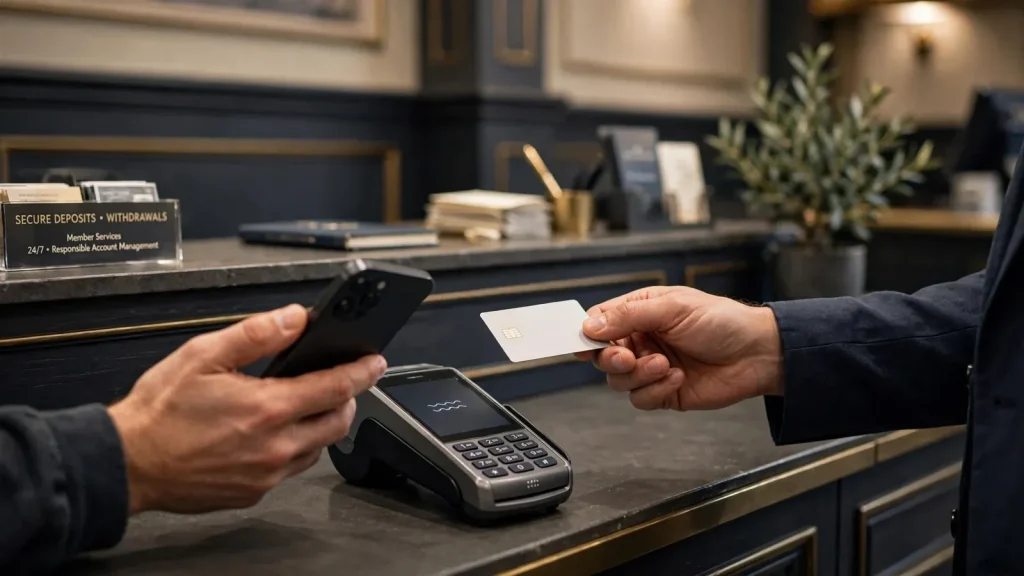
E-wallet options depend on the casino cashier, while deposits and withdrawals may follow different routes.
How E-Wallets Fit into UK Casino Payments
A casino cashier is the point where an account’s payment options become practical. It shows which routes the operator makes available for your account, rather than every method that might exist in the wider payment market. E-wallets sit alongside more familiar routes such as debit cards and bank payments. Their presence can give you another way to move funds, but it does not make the other routes interchangeable: each payment option is handled through its own provider and may be presented differently in the cashier.
For UK players, debit cards remain part of this wider picture. Casinos commonly accept debit cards bearing Visa or Mastercard, although the cashier is where you confirm whether a particular card is accepted for your account. Credit-card payments for gambling are not permitted at UK-licensed casinos. That distinction matters: the card network’s name alone does not tell you whether a card is suitable. The relevant question is whether the product is a debit card and whether the operator’s cashier accepts it.
When choosing a UK casino that accepts e-wallets, payout speed is one practical detail to check. Use the verdicts below as a reference for the payout information available.
-
SlotoSport
- Payout speed
- 1-3 business days
SlotoSport has a stated payout speed of 1–3 business days, which gives you a timeframe to consider when reviewing your options.
-
SpinFormula
- Payout speed
- 1-3 business days
SpinFormula has a stated payout speed of 1–3 business days, which gives you a timeframe to consider when reviewing your options.
-
Chanze
- Payout speed
- 1-3 business days
Chanze has a stated payout speed of 1–3 business days, which gives you a timeframe to consider when reviewing your options.
-
NightLuck
- Payout speed
- 1-3 business days
NightLuck has a stated payout speed of 1–3 business days, which gives you a timeframe to consider when reviewing your options.
-
Zombillion
- Payout speed
- 1-3 business days
Zombillion has a stated payout speed of 1–3 business days, which gives you a timeframe to consider when reviewing your options.
-
NightWin
- Payout speed
- 1-3 business days
NightWin has a stated payout speed of 1–3 business days, which gives you a timeframe to consider when reviewing your options.
-
Revery Play
- Payout speed
- 1-3 business days
Revery Play has a stated payout speed of 1–3 business days, which gives you a timeframe to consider when reviewing your options.
-
Jetsetspins
- Payout speed
- 1-3 business days
Jetsetspins has a stated payout speed of 1–3 business days, which gives you a timeframe to consider when reviewing your options.
-
EvoSpin
- Payout speed
- 1-3 business days
EvoSpin has a stated payout speed of 1–3 business days, which gives you a timeframe to consider when reviewing your options.
-
Britsino
- Payout speed
- 1-3 business days
Britsino has a stated payout speed of 1–3 business days, which gives you a timeframe to consider when reviewing your options.
An e-wallet provides a separate payment route from entering card details directly with the casino. You use the wallet service as the payment method shown in the cashier, subject to the casino and provider supporting the transaction. In practical terms, that means choosing an e-wallet is not simply choosing a different label for a card payment. It introduces another service into the path between your money and the casino account. The cashier tells you whether that route is offered; the wallet provider’s own requirements also apply.
Bank payments form another part of the comparison. Open banking services and bank transfers are not e-wallets, even though all may appear near one another in a payment menu. A specialist review describes open banking and bank transfers as routes that can support instant deposits and fast withdrawals at many sites. Treat that as a site-specific possibility, not a guarantee: the operator’s own cashier and payment information determine what is available to you. The distinction between a bank route and an e-wallet matters because the payment provider, authorisation process and account interface differ.

This is why the cashier’s actual contents matter more than a general description of online casino payments. A site may support several categories, while your account displays only the methods the operator currently makes available to you. If you intend to fund an account with an e-wallet, confirm that the named route appears in the cashier before relying on it. If it does not, a debit card or bank payment may be the available alternative, but those routes should also be checked in the same place.
The choice of route can affect how you manage the transaction. With a card payment, you select a card route; with a bank option, you use a bank-linked process; with an e-wallet, the wallet service is part of the payment. These are different pathways, not merely different buttons for one underlying system. The cashier is therefore useful as a map of the operator’s payment setup. It helps you identify the route you can use without assuming that a method accepted elsewhere will work at this casino.
Payment menus can also put options side by side that serve different purposes. A method suitable for adding funds is not automatically suitable for every later transaction, and a payment label on a general information page does not confirm that the same option is available in your account. For now, the key point is simpler: compare the routes the cashier presents for funding, and distinguish an e-wallet from a card or bank payment rather than treating all electronic payments as one category.
The phrase “e-wallet online casino” can make the payment method sound like the defining feature of a casino. In practice, it is one part of the cashier’s wider setup. A site that accepts e-wallets may also offer debit cards or bank routes; another site may show a different selection. The presence of a wallet option does not by itself tell you whether the rest of the payment experience suits you. It only establishes that the operator offers that route under the conditions shown in its cashier.
Use the cashier as the final reference when you are ready to fund an account. It connects the general payment choices to the methods the operator actually presents, while keeping e-wallets in context alongside debit cards and bank payments. This makes it easier to choose a route based on what is available rather than assuming that every UK casino, or every account at one casino, supports the same set of payment methods.
What to Check Before Choosing an E-Wallet Casino
A suitable e-wallet casino is one whose payment rules fit the way you intend to use your account. The method’s name on a promotional page is not enough: check the cashier and the relevant terms, then compare what they say with your priorities. You may value a familiar wallet, access to a particular promotion or a payment setup that is straightforward to manage. Those priorities can point to different choices.
Check the payment terms alongside the cashier
Start by confirming that your preferred wallet appears as an available method for your account. Then read the casino’s payment terms, rather than assuming that every detail follows from the method being listed. The cashier shows what the operator currently presents for your account; the terms explain how that method is treated under the site’s rules.
This check matters because payment methods can be subject to conditions that are not obvious from a logo or a short promotional description. Look for rules that apply to the method itself, and for any terms that apply only when you claim an offer. If the information is unclear or inconsistent, ask the operator to clarify before depositing. A decision based on the actual rules is more reliable than one based on a general description of e-wallets.

Also consider how much you want your payment choice to influence the rest of your account. If you plan to use an offer, check its terms before selecting a method; if you do not plan to claim an offer, focus instead on whether the cashier supports the wallet you prefer. This keeps the comparison tied to your intended use rather than to a broad label such as “best”.
Treat bonus eligibility as a separate check
A payment method can be accepted for deposits without being eligible for every promotion. That distinction can affect the value of an offer: depositing with a particular wallet may mean you cannot claim it, or may change which terms apply. Read the promotion’s payment exclusions before opting in or paying.
A specialist review reports that PayPal may be excluded from bonus eligibility. This is a reported condition, not a rule that applies to every casino or promotion. Check the specific offer’s terms at the site you are considering. The same careful approach applies to Skrill and Neteller: a specialist review reports that these wallets are often excluded from promotions at sites that accept them, but the operator’s current terms determine eligibility.
If a bonus matters to you, check the payment exclusions and the offer conditions together. Do not infer eligibility from the fact that the cashier accepts a wallet, or from an offer being visible on the site. If you would rather avoid that complication, compare the casino’s payment rules without treating a promotion as part of the decision.
Compare the setup with your own priorities
Before choosing, make a short list of what you need from the payment setup. For example, decide whether using a particular wallet is essential, whether you want to claim a promotion, and whether you are willing to use another method if the terms do not fit. These are practical preferences, not measures of an operator’s overall quality.
- Confirm the preferred wallet is shown in the cashier
- Read the payment terms for the specific method
- Check the bonus rules for payment exclusions
- Match the setup against your personal priorities
Then check each candidate against the same points: is your preferred method shown in the cashier, do the payment terms explain its use, and do the bonus rules allow it if you intend to claim an offer? Keeping the checks consistent makes comparisons clearer. A casino that fits one player’s priorities may not fit yours, even if both accept e-wallets.
A useful decision is one you can explain from the site’s current information: the method is available to you, its conditions are clear, and its treatment under any promotion matches your plan. If one of those points remains uncertain, pause and confirm it with the operator rather than relying on a general claim about e-wallet casinos.
Which E-Wallets and Digital Payment Options May Appear in the Cashier
A casino cashier can show several kinds of digital payment, and the labels do not all describe the same thing. An e-wallet holds or accesses funds through a separate payment account. A mobile payment service can pass a payment from a linked card or account. A prepaid voucher represents value bought in advance. These differences matter because a method’s presence in a cashier does not, by itself, mean it supports every transaction type.
E-wallet accounts
PayPal, Skrill and Neteller are names you may encounter when looking at casino payment options. They are separate payment services rather than bank cards, even when a wallet is funded from a card or bank account. Their appearance is not universal: a casino may offer one, several or none of them.
A specialist review describes Skrill and Neteller as available at some sites, rather than as options at every UK casino. Treat the cashier as the place to confirm what a particular account can use. A payment logo elsewhere on a site may not tell you whether the method is enabled for your account or whether it is available for the transaction you intend to make.
PayPal is another recognisable wallet. A specialist review characterises it as popular for speed and convenience, but that is not a guarantee about the experience at a particular casino. The cashier and the payment terms show whether it is offered there. Payment-method rules can also affect bonuses: a specialist review has reported that PayPal may be excluded from bonus eligibility. Check the offer’s terms before selecting a payment route if you plan to claim one.
Mobile payment services
Apple Pay may appear as a deposit option at some UK Gambling Commission-licensed casinos. It is a mobile payment service, not a casino wallet account. The payment is made through the service using an eligible linked payment source, so the cashier’s Apple Pay option should be understood as a route for making a deposit, not as evidence that Apple Pay is available for every kind of transaction.
This distinction is useful when comparing labels. An e-wallet account and a mobile payment service may both be digital, but they work through different arrangements. If a cashier lists Apple Pay beside wallet brands, that grouping does not make the underlying services interchangeable.
E-wallet accounts
Separate payment services like PayPal, Skrill, and Neteller that hold or access funds.
Mobile payment services
Routes like Apple Pay that pass payments from a linked card or account.
Prepaid vouchers
Deposit-only options, such as Paysafecard, where value is bought in advance.
Prepaid vouchers
Paysafecard is a prepaid voucher used for deposits only. You buy value in advance and enter the voucher details when paying, rather than sending a payment from an e-wallet account. Its deposit-only role is important: seeing it among the cashier’s payment methods does not mean it can be used for payouts.
A voucher can therefore suit a different purpose from an account-based wallet. It gives you a way to fund a casino account with prepaid value, but it should not be mistaken for a reusable wallet balance or a general-purpose route for moving money in both directions.
Other names you may see
Jeton remains available at a handful of UK online casinos in 2026, according to a specialist review. Its presence is limited, so do not assume that a casino offers it simply because it appears in a general list of payment brands. Check the individual cashier for the available method.
Some casino cashiers also group digital payment routes alongside bank-connected services or card options. Those are separate payment categories, even if they appear on the same screen. The name of a service is only the start of identifying what it does: distinguish a wallet account from a mobile service or prepaid voucher, then read the cashier’s description of the transaction it supports.

The practical distinction is between the payment label and its function. Paysafecard is deposit-only; Apple Pay is accepted for deposits at some UKGC-licensed casinos; and e-wallet availability varies by site. Reading each option in that way helps you identify what the cashier is offering without assuming that every digital method works alike.
E-Wallet Availability in 2026: Names and Changes to Know
Payment names can outlast the brands that introduced them, and a familiar name does not guarantee that a method is available at every casino. When comparing UK-facing sites in 2026, it helps to distinguish a rebrand from a payment option that has disappeared. EcoPayz is now known as Payz: the company changed its name in 2022. Skrill, by contrast, continues to appear under its established name.
The EcoPayz-to-Payz change is a rebrand, not evidence that the old name refers to a separate wallet still operating alongside it. If you encounter EcoPayz in older casino information, treat it as a possible outdated label for Payz rather than assuming it identifies a second current payment service. The change also means that a page using the older name may not reflect the wording you see in a casino’s current payment information.
 Casinos That Accept UKash in the UK: What to CheckCompare UKash alternatives, check casino cashier listings, and assess deposit and withdrawal compatibility. Paysafecard is deposit-only.
 Casinos That Accept USDC in the UK: Payment GuideLearn how to verify USDC in a casino’s cashier, distinguish deposit support from withdrawals, and check whether the route is available to…
That distinction matters when you are checking whether a casino accepts a particular e-wallet. A site may update its payment page at a different time from an external review, or an older article may continue to use a name that has since changed. The name alone cannot confirm that the method is currently offered. It can, however, help you recognise that two labels may refer to the same service at different points in its history.
Skrill has not undergone the same name change. A specialist review of UK-facing casinos identifies it as one of the more frequently listed deposit methods in 2026. That is a time-specific assessment from a type of review, not a guarantee that every UK casino accepts Skrill, or that its availability will remain unchanged. Individual operators can set their own payment options, so the presence of a familiar brand elsewhere does not establish its availability at a particular casino.
The EcoPayz to Payz rebrand
EcoPayz changed its name to Payz in 2022. If you see EcoPayz in older information, it likely refers to the current Payz service rather than a separate payment option.
For the same reason, a list of casinos that accept e-wallets can become dated even when the operator names remain current. A payment provider may change its brand, while a casino may add or remove a method independently. These are separate changes: one concerns what the payment service is called; the other concerns whether a particular casino offers it. A comparison that does not distinguish between them can make old information look current.
When reading material from different years, pay attention to the date and the exact payment name used. An older reference to EcoPayz may be describing Payz under its former name; a current reference to Skrill is still using that provider’s name. Neither wording, by itself, confirms what is available to you now. The casino’s own current payment information is the relevant place to confirm whether a named service is offered.
The useful takeaway for 2026 is narrow but practical: recognise Payz as the name that followed EcoPayz, and do not mistake that rebrand for two separate options. Skrill remains a recognisable e-wallet name in current specialist casino coverage, but its continued mention is not universal availability. Keeping those points separate helps you read older and newer references without treating a historical label as a current cashier listing or a broad review finding as a promise about an individual site.
Why Deposits and Withdrawals May Use Different Routes
A payment method shown in a casino cashier can accept a deposit without becoming the route used for a later payout. Depositing money and returning a balance are separate transactions, and the rules governing the second transaction may restrict where the money can go.
For UK players, anti-money laundering requirements are a key reason. Remote gambling operators commonly return funds to the original payment source. This closed-loop approach helps show that money is going back through the route from which it came, rather than being sent to an unrelated destination. It is also an anti-fraud control: limiting the route for a payout can make it harder to use a casino account to move funds between unrelated payment accounts.

That means an e-wallet deposit does not, by itself, prove that the casino will pay winnings into that wallet. The operator may need to return funds to the original source, or apply its own payment rules where the original route cannot be used. A casino’s list of methods for deposits and its payout arrangements are not necessarily identical.
If the original source is unavailable or cannot receive the payment, an alternative route may be considered. That change can require additional verification before the operator sends funds. The purpose is to establish that the requested destination is acceptable, not simply to offer a different option for convenience. The casino may therefore ask for information or documents before processing a payout through another route.
When comparing casino sites that accept e-wallet deposits in the UK, check the payout terms as well as the deposit options. Look for wording about returning funds to the original source, how the operator handles an unavailable source, and whether another destination triggers checks. A method being visible in the deposit cashier is not enough to establish that it can also receive withdrawals.
This distinction matters even if you intend to use only one payment method. If a payout cannot follow the route you expected, the casino may need to review the proposed alternative, and the transaction may not proceed until that review is complete. Treat the cashier and the payment terms as separate pieces of information: one shows what may be used to fund an account, while the other explains how funds may be returned.
Check Payment Availability and Currency Before You Deposit
A payment method shown on a casino’s general payments page is not proof that you can use it for your own deposit. A page may describe the methods the operator supports, while the cashier shows which options are currently available for your account. Treat the cashier as the practical check: sign in, open the deposit screen and confirm that your intended method appears as a selectable option before you proceed.
This matters for cards as well as e-wallets. Specialist casino reviews may list Visa and Mastercard, but current UK availability and eligibility can depend on the card product. Check the cashier rather than assuming that every card carrying one of those names will work. UK-licensed casinos cannot accept credit-card payments for gambling, so a card’s brand alone does not establish that it is eligible.
The same distinction applies when you are comparing online casino sites that accept e-wallet deposits. A method listed in a review or on a general information page may not be available in the cashier when you log in. If the option is absent, do not assume that repeatedly trying to submit the payment will make it available. Choose a method the cashier actually offers, or contact the operator to clarify the situation before paying.

Currency is a separate compatibility check. Operator payment pages may state that GBP is supported, but confirm the currency assigned to your casino account before making the first transaction. The currency shown in the cashier is the relevant detail: if your account is set to a different currency, the payment may be converted rather than credited in pounds. Do not rely on a site’s general statement about GBP without checking the account itself.
Before authorising a deposit, check both parts of the transaction: that the method is available for you and that the displayed currency matches your intention. If the cashier presents a currency you did not expect, pause and find out whether the account currency can be changed before proceeding. This avoids treating a general list of supported methods as a guarantee of access, or mistaking a supported currency for the currency already selected on your account.
For a UK player comparing casinos that accept e-wallets, the useful evidence is therefore the live cashier and the account’s currency setting, not a payment logo alone. Verify those details at the point you are ready to deposit, because general pages and reviews describe availability in broader terms than the options shown for an individual account.
Use Matching Account Details to Reduce Payment Friction
When you open an account at an e-wallet casino, make sure the casino profile and the wallet belong to the same person. The names and other basic account details should match. If they do not, the casino may need to establish who controls the payment route before it can handle the transaction. Matching details reduce the chance of avoidable ownership checks; they do not remove the casino’s ability to request information.
Do
- Ensure casino and wallet profiles use the same name
- Keep account details current on both platforms
- Use one consistent route for deposits and withdrawals
Don't
- Use a family member's card or wallet
- Use a payment account you cannot prove you own
- Switch between several different wallets frequently
This is a matter of identity, not simply of entering the payment details correctly. A wallet in your name does not become yours for casino-payment purposes because you can access it, and a family member’s card or wallet is not a substitute for your own. Using another person’s payment account can leave the casino unable to confirm that the funds and the gambling account have the same owner. That can create extra questions or delay processing while the details are checked.
Consistency also matters across transactions. Where the casino supports it, using one named account for deposits and withdrawals gives the payment record a clearer link to your casino profile. Changing between several wallets or accounts can make that link less straightforward, even if each account is accessible to you. A single, consistently used route is often the cleanest arrangement.
Before depositing, check that the name on your casino account matches the name registered with your e-wallet, and that both sets of details are current. If you have made a mistake in your profile, correct it through the casino’s account process rather than trying to work around the mismatch with a different payment account. If your name has changed, contact the casino and wallet provider about updating their records.
These steps cannot guarantee that a transaction will pass without review. They do, however, prevent basic ownership discrepancies from adding friction to an otherwise straightforward payment. For someone choosing among e-wallet casinos in the UK, a useful practical test is whether the casino account and the intended wallet can both be maintained in the same customer’s name and used consistently.

Compare the Full Cost of an E-Wallet Payment
The amount shown in the casino cashier is not necessarily the full cost of funding your account. A transaction may involve a casino charge, a fee from the e-wallet provider, a charge from your bank or card issuer, a currency-conversion spread, or a network fee. Which of these applies depends on the payment route and the terms set by the parties handling it.
Separate the costs by asking who charges them and when. A casino fee may appear at the payment stage, while a provider or bank charge may be recorded in a separate transaction entry. A conversion spread is less obvious: it is the difference between the exchange rate applied to your payment and a reference rate. You may not see it labelled as a fee, so compare the amount debited in your wallet’s base currency with the value credited to the casino account.
A specialist payment review identifies conversion spread as a possible cost that can exceed a visible flat charge. That does not mean it will do so for every transaction; the result depends on the rate and the amount converted. Check the rate shown before confirming, where available, and look at the provider’s transaction record afterwards to see what was actually charged.
If a payment route uses a network, check whether that network adds a fee as well. Do not assume that a small or absent casino charge makes the transaction free: costs may sit with the provider, bank, issuer, or network instead.
For a useful comparison, use the same intended deposit amount and add every applicable charge, including any loss from conversion. Check the casino’s cashier and payment terms alongside the e-wallet provider’s fee information; neither view necessarily shows the full cost on its own. There is no single payment method that is always the cheapest. The result can change with the transaction amount, the casino’s charges, provider fees, exchange rate, and network cost. Compare the total for the payment you plan to make, rather than choosing by a fee label alone.
Deposit Limits and Financial Controls for UK Players
A deposit limit can refer to two different controls: the amount a casino allows through a particular payment method, or a personal financial limit set on your account. The first can affect whether a transaction is accepted; the second helps you control how much you put into gambling.
A specialist review describes minimum deposits at UK casinos as commonly falling between £10 and £20, with the amount depending on the payment method. Treat that as an indication, not a fixed rule: the cashier should show the minimum that applies to the method you select. A low minimum does not mean that the same route will accept a large payment.
Maximums can also be set per transaction, per day or per month. A specialist review notes that these caps may differ by payment method and account status. The limit shown for one e-wallet may therefore differ from the limit for another, and an account’s permitted amount may change with its status. Check the cashier and account information before planning a deposit; do not assume a limit displayed for another method or customer applies to you.
Personal financial limits work separately from payment caps. UK Gambling Commission rules require remote gambling operators to ask new customers to set a financial limit before they make their first deposit. They must also provide accessible controls at account level. These controls let you set a boundary for your own account; they do not increase a payment provider’s cap or override a casino’s transaction limit.
Before paying, distinguish the figures on screen. A minimum is the least the selected method will accept, while a maximum is the most it will allow under the stated conditions. Your account-level limit is your own control over gambling spend. If a deposit is declined, check both the method-specific cap and your personal limit rather than repeatedly submitting the same amount.
An e-wallet casino list cannot tell you which limit applies to your account at the moment of payment. The cashier is the relevant check: confirm the selected method’s minimum and maximum, then review your account-level limit before authorising the transaction.
What Determines How Quickly a Withdrawal Arrives
A fast deposit does not predict how quickly a withdrawal will be completed. The payment into your account and the casino’s approval of a payout are separate stages, and the second can involve checks that were not needed to accept the deposit.
 Casinos That Accept Tether in the UK: Payment ChecksLearn how to verify USDT in your account’s cashier, check network support, and review fees, bonus terms and cash-out requirements before transferring.
 Casinos that accept Citadel in the UK: payment checksLearn how to check Citadel in a casino cashier, confirm account-specific availability and understand deposit, bonus and withdrawal considerations.
A specialist review identifies internal approval and account verification as factors that can affect withdrawal timing. After you request a payout, the casino may need to review the request before authorising it. The payment is not ready to be processed until that approval stage is complete, so the time shown for payment delivery may not include the casino’s own processing period.
KYC can also affect the first withdrawal. If the casino still needs to verify your account, it may request information or documents and pause processing while those checks are completed. A first payout can therefore take longer than later ones, when the account is already verified. The exact process depends on the casino and the status of your account.
To reduce avoidable delays, complete any requested account checks before making a withdrawal and look for the casino’s stated processing information. If a payout is taking longer than expected, check whether the request is still awaiting casino approval or whether further verification is required. Those stages explain why a deposit that appeared immediately does not mean the corresponding withdrawal will arrive just as quickly.
Why must withdrawals return to the deposit method?
Returning funds to the original payment source is a common anti-fraud and anti-money-laundering control. An alternative route may require additional verification.
What is the fastest withdrawal method for UK casinos?
PayPal, open banking services and debit cards linked to fast payout systems are generally among the quickest options. Check the casino’s cashier and payment terms, as processing speed also depends on its approval process and your verification status.
Which method has the lowest fees?
There is no universal lowest-fee method. Compare the casino’s charges, provider or bank fees, currency-conversion spread and any network costs for the specific amount you plan to transfer.
Do UK casino withdrawals require verification?
Verification may be required, particularly for a first withdrawal. Completing it can affect how quickly the casino approves a payout.
Why can a fast payout casino still delay my withdrawal?
A casino’s internal approval process can delay a payout, and verification may take longer for a first withdrawal. An account that is not fully verified can also affect withdrawal speed.
Are fast casino withdrawals guaranteed?
No. Withdrawal speed depends on the casino’s approval process and whether your account is fully verified.
Is Skrill available?
Yes, Skrill is available at some UK-friendly casino sites and remains a common deposit method. Check the cashier for availability on your account; Skrill may be excluded from promotions.
Payments at UK Casinos: Cards, E-Wallets and Crypto
Content created by the «goodthingsshare» team