
Check Visa Payments Before Funding a Casino Account
 Available in US
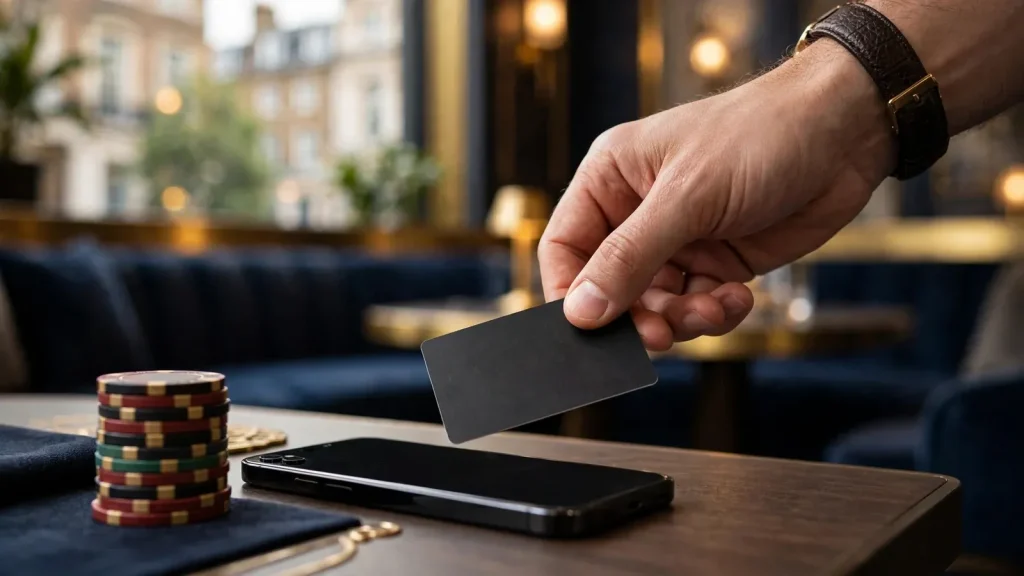
Visa can fund eligible real-money play, but availability depends on the casino and deposit and withdrawal options may differ.
Using a Visa Card for Online Slot Deposits
A Visa deposit is the payment step that moves money into a casino account so it can be used for real-money play. It does not change the slot itself, its rules or the legal conditions under which the casino may offer it. Treat the payment and the game as separate parts of the same account: Visa concerns funding, while British gambling requirements govern access to the account and play.
UK casinos commonly accept debit cards, including Visa and Mastercard. That broad pattern does not mean every Visa product will be available at every site; the payment options shown by a casino can depend on its own arrangements. Before treating a card as usable, look at the operator’s current payment information. The relevant point here is that Visa can be a route for adding funds, not a special type of slot account or a way to alter game rules.
At a basic level, you select the card option in the casino’s cashier, enter a deposit amount and provide the requested payment details. If the payment is accepted, the casino credits the account balance. You can then use that balance for eligible real-money games, including online slots offered by the operator. If the payment is declined or not completed, the balance is not funded through that attempt. The cashier and account statement are the places to distinguish a completed deposit from one that is still pending or has failed.
If you’re looking for a UK casino that accepts Visa, payment details matter as well as the games on offer. Use this list as a starting point, and check each casino’s current Visa availability before you deposit.
-
SlotoSport
- Payout speed
- 1-3 business days
SlotoSport has a stated payout speed of 1–3 business days. Check whether Visa is currently available to you before depositing.
-
SpinFormula
- Payout speed
- 1-3 business days
SpinFormula lists payouts at 1–3 business days. Confirm its current Visa options before you deposit.
-
Chanze
- Payout speed
- 1-3 business days
Chanze has a stated payout speed of 1–3 business days. Check current Visa availability if that’s your preferred payment method.
-
NightLuck
- Payout speed
- 1-3 business days
NightLuck lists a payout speed of 1–3 business days. Make sure Visa is currently offered to you before depositing.
-
Zombillion
- Payout speed
- 1-3 business days
Zombillion has a stated payout speed of 1–3 business days. Verify its current Visa options before you deposit.
-
NightWin
- Payout speed
- 1-3 business days
NightWin lists payouts at 1–3 business days. Check whether Visa is available for your account before depositing.
-
Revery Play
- Payout speed
- 1-3 business days
Revery Play has a stated payout speed of 1–3 business days. Confirm current Visa availability before you use it.
-
Jetsetspins
- Payout speed
- 1-3 business days
Jetsetspins lists a payout speed of 1–3 business days. Check its current Visa options before making a deposit.
-
EvoSpin
- Payout speed
- 1-3 business days
EvoSpin has a stated payout speed of 1–3 business days. Verify Visa availability for you before depositing.
-
Britsino
- Payout speed
- 1-3 business days
Britsino lists payouts at 1–3 business days. Check whether Visa is currently available to you before you deposit.
A card deposit does not itself establish that a site is permitted to offer gambling to customers in Great Britain. Remote gambling licensees serving consumers in England, Scotland and Wales need the relevant UK Gambling Commission licence, wherever the business is based. A casino’s payment branding is therefore not proof of its regulatory status. The legal question concerns the operator and the service it provides; Visa is only the payment method shown within that service.
Age and account controls also apply independently of the card. Operators must verify a customer’s age before allowing a deposit into a gambling account. A successful card payment is not a substitute for that verification, and having a Visa card does not establish that you are eligible to gamble. Remote operators must also prompt new customers to set a financial limit before the first deposit and make account-level limit controls accessible. These are account safeguards, not Visa settings: changing the card does not remove them.
The rules for online slots apply after the account has been funded. The maximum stake for a single online slot game cycle is £5 for customers aged 25 and over, and £2 for those aged 18 to 24. The £5 limit for all adults took effect on 9 April 2025. This is a limit on the stake in the game cycle, not on the amount you may place on a Visa card deposit. A deposit amount and a slot stake are different quantities governed by different controls.
That distinction matters when you plan to play. Money credited to an account is not automatically a permitted stake of any size. The casino’s game interface and account controls must apply the relevant restrictions, while the deposit process records how funds enter the account. If you fund an account with Visa, the same slot rules apply as they would to funds deposited by another accepted route. Payment method does not create an exemption from stake limits or other requirements imposed on remote gambling licensees.

The wording “Visa casino” can blur these separate questions. It may refer to a casino that lists Visa as a way to deposit, but that label alone says nothing about which slots are offered, whether a particular payment product will work, or what rules govern a game. Likewise, a slot does not become a “Visa slot” because the account holding its balance was funded by card. The game remains subject to the operator’s terms and the British regulatory framework.
When you consider a Visa-funded slot account, keep the sequence clear: the operator must be entitled to serve the market; the customer must meet the age and account requirements; the cashier must accept the chosen payment; and the game must operate within the applicable slot rules. Each step answers a different question. Confusing them can lead you to mistake payment acceptance for regulatory approval, or a credited balance for permission to stake beyond the legal limit.
Check Visa Availability Before You Deposit
A casino’s payment page may name Visa, but that does not establish that Visa is available to every UK customer or that every Visa card product can be used. A payment-method list is a general indication of support; the options shown in the cashier are the more relevant check for your account. Treat those as separate questions: does the casino support Visa in principle, and is Visa available to you, with your card, at the point you intend to use it?
A specialist review may list Visa and Mastercard among a casino’s supported methods. That information can help you identify a site to investigate, but it may not reflect the current UK cashier or the eligibility of your particular card product. Availability can depend on the operator’s current payment arrangements and the product presented by your card provider. The card logo alone cannot resolve that. Check the cashier after signing in, rather than assuming that a general payment page describes the options enabled for your account.

What to check in the cashier
Look for Visa as a selectable payment option, not merely as a logo or a mention in general terms. If the cashier distinguishes between card products, check which of those it lists. A displayed Visa option is useful evidence of availability, but it does not prove that every card carrying the Visa mark is eligible. If your product is not clearly covered, the operator’s payment information or customer support can clarify whether that particular card type is accepted.
Also check whether the option is presented for UK customers. A casino can serve customers in multiple countries, and its payment arrangements may differ by market. A page describing Visa support without specifying the relevant market does not confirm that the same option is available to a UK account. The cashier is the place to check the current selection for your own account; do not infer UK availability from a page aimed at another country.
If Visa does not appear, do not treat a generic Visa logo elsewhere on the site as confirmation that you can select it. The site may describe a method that is not currently enabled for your account or market. Conversely, a general page may not show every option available in the cashier. The practical distinction is between a broad statement about supported methods and the payment choices actually presented to you.
Confirm the account currency as well
Currency is a separate compatibility check. A specialist review may report that a casino supports GBP, but you should confirm the currency assigned to your account before the first transaction. A statement about GBP support does not necessarily tell you which currency your particular account uses.
This matters because the displayed account currency determines whether a card payment is handled in pounds or involves conversion. Check the account settings or the currency shown in the cashier before proceeding. If the account is set to a different currency, the fact that the site supports GBP in general does not by itself mean your account is configured in GBP. Resolve that uncertainty before making a payment, rather than assuming the site will select the currency you expect.
Do
- Check for Visa as a selectable option in the cashier
- Verify your account currency is set to GBP
Don't
- Rely on a general Visa logo on the payment page
- Assume UK availability from a page aimed at another country
Keep the checks distinct. Visa availability concerns whether the method and your card product are offered to your UK account. Currency concerns the denomination used for that account. Seeing Visa in a list does not settle the currency question, and seeing GBP mentioned on a casino page does not establish that Visa is available to you.
When the information is unclear
If the cashier names Visa but gives no detail about eligible card products, ask the casino to confirm whether your card type is supported for a UK account. If the cashier does not show Visa at all, ask whether the method is currently available to UK customers before relying on a broad claim elsewhere on the site. A clear answer should address your market and card product, rather than simply repeating that the casino accepts Visa.
Do not treat a casino’s general branding, a payment logo, or an old review as a substitute for the current cashier information. Those clues can point you towards a method to check, but they cannot establish the options enabled for your account today. Confirm Visa availability and account currency separately, then decide whether the details match what you intend to use.
How to Confirm a Casino Accepts Visa
To establish whether a casino accepts Visa, look for a clear statement from the casino itself, then check that the same method appears in the payment options available to you. A logo on a page can indicate that Visa is supported in some context, but it does not, by itself, show that the method is currently offered to every customer.
Start with the casino’s cashier or payments page. Look for Visa named as a card option, rather than relying on a generic reference to “cards”. If the site has separate information for deposits and other payment services, read the relevant section carefully: a Visa logo or mention does not necessarily describe every use of the method. The wording should make clear what the casino offers.

Next, compare that information with the operator’s terms or payment FAQ. These pages can explain whether the listed option applies to the casino account you are viewing and may flag conditions that are not shown beside the logo. If the pages disagree, treat the support as unconfirmed and ask the casino’s customer service team to clarify. A specific answer about Visa is more useful than a general statement that the operator accepts card payments.
A specialist review that examines casino payment information may list Visa alongside Mastercard, bank transfer, e-wallets and cryptocurrencies. That can help you identify a site worth checking, but it is secondary evidence: payment information can change, and a review may describe what was listed when it was written. Confirm the method against the casino’s own current information rather than treating a third-party list as proof of present availability.
Check the scope of the claim, too. “Visa accepted” could refer to a payment option in general, without specifying whether it is available to UK customers or to the account you are using. Look for wording that explicitly relates to the UK, and make sure you are viewing the correct regional version of the site. If the site does not state the relevant scope, ask the operator rather than assuming that a logo settles the question.

There is also a difference between a casino mentioning Visa and showing it as an available option. A page may display payment brands as general information, while the cashier provides the current list for your account. Treat the cashier as the practical confirmation point; use the payments page and terms to understand the operator’s description, not as a substitute for checking the option there.
For UK-facing sites, payment information is only one part of deciding whether the casino is appropriate to use. Remote gambling operators serving Great Britain must hold the relevant UK Gambling Commission licence, so check the operator’s status on the Commission’s public register as well. A Visa logo does not establish that status.
In short, look for Visa in the casino’s own current payment information, confirm that the wording applies to UK customers, and resolve any conflict with the operator directly. That gives you a firmer answer than a brand image or an older review, without assuming that every site displaying Visa offers it in the same way.

Visa Debit Cards and the UK Credit Card Ban
A Visa logo identifies the card network, not the source of the money. A Visa debit card draws on funds in a bank account; a Visa credit card uses credit provided by the card issuer. That difference determines whether the card can be used for gambling payments at a UK-licensed casino. The credit-card ban does not prohibit Visa as a brand or prevent debit-card payments simply because they use the Visa network.
The regulator introduced the ban on credit-card gambling on 14 April 2020, and it remains in force. Remote gambling licensees must not accept credit-card payments for gambling. So, when you see that online casinos accept Visa, do not assume every Visa card is eligible: the relevant distinction is whether your card is debit or credit, not the familiar logo on its face.
Before paying, check the card type in your banking app or account details. A card described as Visa Debit is different from a Visa credit card, even if both look similar and carry the same network branding. If the card is credit, it is not a permitted way to fund gambling at a UK-licensed casino. Do not treat a declined credit-card payment as a prompt to route the same credit through another payment service.

The restriction also covers credit-card funds passed through a money service business. A digital wallet does not make the underlying source irrelevant: UK rules prevent a casino from accepting a wallet payment where the wallet allows credit-card funds to be used for gambling. Moving money from a credit card into a wallet and then paying the casino would therefore not create an acceptable workaround. The payment route may look different on screen, but the source of the funds still matters.
This is why “Visa accepted” is not a complete answer to whether your particular card can be used. It describes a payment method at a broad level; it does not mean that a credit product is allowed. For casinos accepting Visa debit cards in the UK, the practical boundary is that the card must be a debit product, and any wallet route must not make credit-card funds available for gambling. A Visa credit card remains outside that boundary even if the casino’s cashier displays Visa as an available brand.
Keep the distinction clear when comparing online casinos accepting Visa payments. A debit card may be an available form of payment, while credit-card payments for gambling are prohibited. If you are unsure which type of Visa card you hold, confirm it with the card issuer rather than relying on the network logo or a general payment label. This prevents confusing acceptance of Visa debit with permission to use credit.
Visa Deposits and Online Slot Rules
A Visa deposit and the rules for playing online slots are separate parts of the account. Visa is a way to add funds; it does not set the stake, change a game’s controls or alter the rules a remote gambling licensee must follow. UK casinos commonly accept debit cards, including Visa and Mastercard, but card acceptance alone says nothing about the slot features available or the conditions that apply to play.
Once funds are in your account, the operator’s slot controls and the rules for the British market govern each game. In Great Britain, online slot autoplay is banned. You must start each spin yourself rather than setting the game to repeat spins automatically. A slot spin must also last at least 2.5 seconds. These requirements apply regardless of whether the account was funded with Visa.
Stake limits are another part of the game rules, not a property of the payment card. The maximum stake for an online slot game cycle is £5 for customers aged 25 and over, and £2 for customers aged 18 to 24. The £5 limit for all adults aged 25 and over took effect on 9 April 2025. A Visa deposit cannot raise these limits, and the amount you place in your account does not change the maximum stake permitted for your age group.
These distinctions matter when comparing slot offers or deciding whether a site suits your intended play. A promotion mentioning slots does not override the stake cap, autoplay ban or minimum spin duration. Nor does seeing Visa beside a casino’s payment information establish that a particular game, bonus or mobile feature is available to you. Payment branding answers a narrow question about funding; game rules and account terms answer different questions.

Before you play, the operator must verify your age before allowing deposits into a gambling account. Online gambling is legal in the UK for people aged 18 and over when the operator holds a UK Gambling Commission licence. Remote gambling licensees serving Great Britain must hold the relevant licence, and UKGC rules require them to prompt new customers to set a financial limit before their first deposit and make account-level limit controls accessible. Those protections apply at account level, rather than being supplied by Visa.
If you are using a phone, the same distinction still applies: the device and payment route do not exempt a slot from British requirements. Look at the game’s controls and the operator’s account information, not the card logo, to understand how play is managed. A site accepting Visa may offer slots, but the card itself is not evidence that a particular game is suitable, that an offer applies, or that a game can be played outside the rules.
Alternatives to Visa for Casino Payments
If Visa is not the route you want to use, alternatives differ in how they fund an account and whether they can be used beyond a deposit. Check the casino’s cashier and payment terms before choosing: a method appearing on a general payment page does not establish that it is available for every account or that it qualifies for a promotion.

PayPal is an account-based payment service. A specialist casino review describes it as popular for speed and convenience, but also notes that PayPal deposits may be excluded from bonus eligibility. Treat that as a reason to check the specific offer’s terms, not as a rule that applies at every casino. If a promotion matters to you, confirm that the payment method is eligible before making the deposit; otherwise, the deposit may not meet the offer conditions.
Skrill and Neteller are e-wallets offered by some casino sites. A specialist casino review reports that these methods are often excluded from promotions. Availability and bonus eligibility are separate questions: seeing an e-wallet in the cashier does not confirm that a deposit made with it can be used to claim an offer. Read the promotion terms for any named payment exclusions.
Paysafecard works differently from an e-wallet. It is a prepaid voucher for deposits only, so it does not provide a route for receiving casino funds. Consider that distinction before selecting it: a method that can fund an account may still be unsuitable if you expect to use the same method for other account transactions.

Apple Pay is another possible deposit route. Some UK Gambling Commission-licensed casinos accept it for deposits, but acceptance is not universal. Its appearance as a payment option should be confirmed at the casino itself, rather than assumed from the fact that a site supports other card-based payments.
The practical comparison is therefore about more than the name of a method. A voucher is deposit-only; an e-wallet may have promotion conditions; and a mobile-wallet option may be available only at some licensed casinos. Before paying, check the cashier for the method offered to your account and the relevant terms for bonuses or other restrictions. If you are comparing alternatives to Visa for online casinos in the UK, start with the function you need, then confirm the site’s conditions for that specific route.
What Happens When You Pay by Visa
A Visa deposit passes through several linked stages: you make a request in the casino account, the card payment is submitted for processing, and the casino updates your balance if the transaction is accepted. The precise screens and prompts vary by site, but the basic sequence is similar.

First, you sign in and open the cashier. You choose Visa from the payment methods shown, enter a deposit amount and provide the requested card details. The casino may also ask you to confirm the transaction through a security step set by your card issuer. Follow the prompts shown on screen; submitting the form alone does not mean the deposit has been completed.
The payment then needs to be authorised and recorded. If accepted, the casino credits the account and displays the updated balance or a transaction confirmation. If it is not accepted, the balance may remain unchanged and the cashier may show a decline or ask you to try again. A displayed error is a reason to check the transaction status before submitting another request, so you do not accidentally make a duplicate payment.
The account details matter throughout this process. Use a casino account in your own name and a Visa card linked to you. When the customer information attached to the gambling account and the payment route identifies the same person, basic ownership checks are less likely to create avoidable friction. A mismatch can lead to questions or a request for further information because the casino needs to establish who is funding the account.
Visa Deposit Process
-
1
Selection
Sign in, open the cashier, and choose Visa from the available payment methods.
-
2
Details
Enter your deposit amount and provide the requested card details, following any security prompts from your issuer.
-
3
Confirmation
Check your account balance or transaction history to ensure the payment was recorded and credited.
Keep the details consistent rather than switching between accounts or using someone else’s card. The simplest arrangement is one named account used consistently for depositing and, where permitted, withdrawing. This makes the relationship between the casino account and payment account easier to understand if the casino reviews a transaction.
Before confirming, check the amount and the account you are logged into. After submitting, use the casino’s transaction history or confirmation message to see whether the payment was recorded. If the casino balance has not changed, do not assume the card has been charged or that the transaction has failed: check the status with the casino and, if needed, your card provider before trying again.
This sequence explains how a Visa payment reaches a casino balance; it does not determine what happens when you later request a payout. Depositing successfully is not a promise about payout timing or the route a withdrawal will take. Those depend on separate controls, so keep the confirmation and use matching account details if the casino asks you to clarify a transaction.
Why a Visa Deposit Does Not Guarantee a Visa Withdrawal
A Visa deposit and a payout are separate transactions. The fact that a casino accepts a Visa card for deposits does not, by itself, show that it can return winnings to that card. The cashier’s withdrawal information and the casino’s terms determine which payout routes are available to your account.
UK anti-money laundering rules generally require a casino to return funds to the original payment source. This is part of a control known as closed-loop processing: the casino checks where funds came from and directs a payout back through an eligible route associated with that source. If you deposited by Visa, the casino may therefore try to return funds to the same card. That does not mean every Visa card can receive a payout or that every casino processes card withdrawals in the same way.

The payment route can also affect what happens when the original source cannot receive the funds. The casino may need to verify the account or ask you to use another permitted route. Do not assume that you can select any payout method simply because it appears in the cashier; the casino may need to confirm ownership and apply its payment controls first.
Timing is another distinction. A card payment can appear in the casino account quickly, while a withdrawal has additional stages. A specialist review reports that a Visa deposit can be instant while a payout may take several business days. That is a reported timing example, not a promised processing time for every casino or card.
A specialist review also notes that the casino’s internal approval is part of the withdrawal process and that first withdrawals may take longer while verification is completed. In practice, the casino must review the request before the payment provider or card issuer can finish handling it. An account that still needs checks can therefore take longer than one whose verification is complete.
Before relying on Visa for both directions, read the withdrawal terms and check the cashier for the payout routes available to you. Look for whether Visa is listed for withdrawals, whether the original card must be used, and whether another route may be required after review. Treat “Visa accepted” as information about payment support, not as evidence of an instant or guaranteed Visa withdrawal.
Deposit Amounts, Limits and Payment Costs
A Visa deposit does not have one fixed minimum across UK casino accounts. A specialist casino review reports that minimum deposits commonly fall between £10 and £20, with the threshold depending on the payment method. Treat that as a guide, not a guaranteed Visa minimum: the cashier’s stated minimum is the amount that applies to your account at that time.

The maximum is a separate control. Casino terms may set caps per transaction, per day or per month, and the applicable cap can depend on both the payment method and your account status. Check the relevant limit before deciding how much to deposit; a stated daily maximum, for instance, does not tell you the monthly allowance.
Your account also has a financial-control setting. UK Gambling Commission rules require remote gambling licensees to prompt new customers to set a financial limit before their first deposit and to make account-level limit controls accessible. A limit you set can therefore restrict what you can deposit even when the cashier’s payment cap would allow more. Check both controls rather than treating the payment limit as your available budget.
The amount credited is not always the only cost to consider. A specialist casino review identifies possible charges from the casino, payment provider, card issuer or bank, alongside currency-conversion spreads and network fees. Which of these applies depends on the transaction and its route; there is no universally cheapest payment method. Compare the charges for the amount you intend to deposit, including the exchange rate rather than only any visible flat fee.
Before paying, check that your casino account is set to GBP. If it uses another currency, conversion may add cost even when the displayed deposit amount looks clear. The cashier and account terms are the useful reference points for the actual minimum, maximum and any charges attached to your proposed deposit.

Visa Acceptance Does Not Tell You a Casino’s GamStop Status
Visa acceptance answers a payment question: whether the casino offers Visa for eligible transactions. It does not show whether the operator is part of GamStop, whether a particular account is covered by a self-exclusion, or what account controls are available. A Visa logo is not evidence either way.
Treat these as separate checks. To establish GamStop status, consult the scheme’s own information and the operator’s published terms or support team. Do not infer that a casino is outside the scheme because Visa appears in its cashier, or assume it is included because it serves customers in the UK. Payment branding cannot confirm either conclusion.
The distinction matters if you are looking for casinos not covered by GamStop or trying to work out whether an existing exclusion applies. If you have self-excluded, do not use payment availability as a way to bypass that choice. Check the scope of your exclusion directly and use the support and account controls available to you.
A casino’s status also does not replace a separate check of its legal position. Remote gambling operators serving the British market must hold the relevant UK Gambling Commission licence. Check the licence details on the Commission’s public register; Visa acceptance is not proof of a current licence.
Account-level safeguards are another separate issue. Remote operators must make new customers choose a financial limit before they make their first deposit, and must make limit settings accessible through the account. These controls concern how you manage gambling activity; they do not establish GamStop membership or change what a Visa logo means.
Nor does a Visa listing establish that deposits are fee-free. Check the operator’s payment terms for any charges rather than treating card acceptance as evidence about cost. In short, assess payment availability, GamStop status, licensing and account controls independently. Each answers a different question, and none can be inferred from the Visa brand alone.
Are Visa and Mastercard deposits definitely debit cards?
No—not every card carrying a Visa or Mastercard logo is necessarily eligible. UK casinos commonly accept debit cards, but check the cashier for your card product; credit card gambling has been banned since 14 April 2020.
Why must withdrawals return to the deposit method?
Returning funds to the original payment source is a common anti-fraud and anti-money-laundering control. Using the same account for deposits and withdrawals can also reduce avoidable transaction checks.
What is the current minimum deposit?
The minimum deposit usually starts at £10–£20, depending on the payment method.
Which payment methods are accepted in Great Britain?
Common options include Visa and Mastercard, bank transfer, e-wallets such as PayPal, Skrill and Neteller, and—in some casinos—Apple Pay. Paysafecard is for deposits only, and the options available to you should be checked in the cashier.
Which method has the lowest fees?
There is no universally cheapest method. Compare casino and provider charges, bank or issuer fees, currency conversion spreads and any network costs for the amount you plan to transfer.
What is the fastest withdrawal method for UK casinos?
PayPal, open banking services and debit cards linked to fast payout systems are generally among the quickest. The casino’s approval process and your verification status also affect how soon you receive the money.
Do UK casino withdrawals require verification?
Yes, verification may be required, and first withdrawals can take longer while checks are completed. Keeping your account details and payment route in your own name can help avoid basic ownership issues.
Why can a fast payout casino still delay my withdrawal?
A casino’s internal approval can take time, particularly for a first withdrawal when verification is being completed. Bank transfer cut-off times, weekends and currency conversion can also affect delivery.
Payments at UK Casinos: Cards, E-Wallets and Crypto
Content created by the «goodthingsshare» team