
Make sense of bingo rooms and slot options
 Available in US
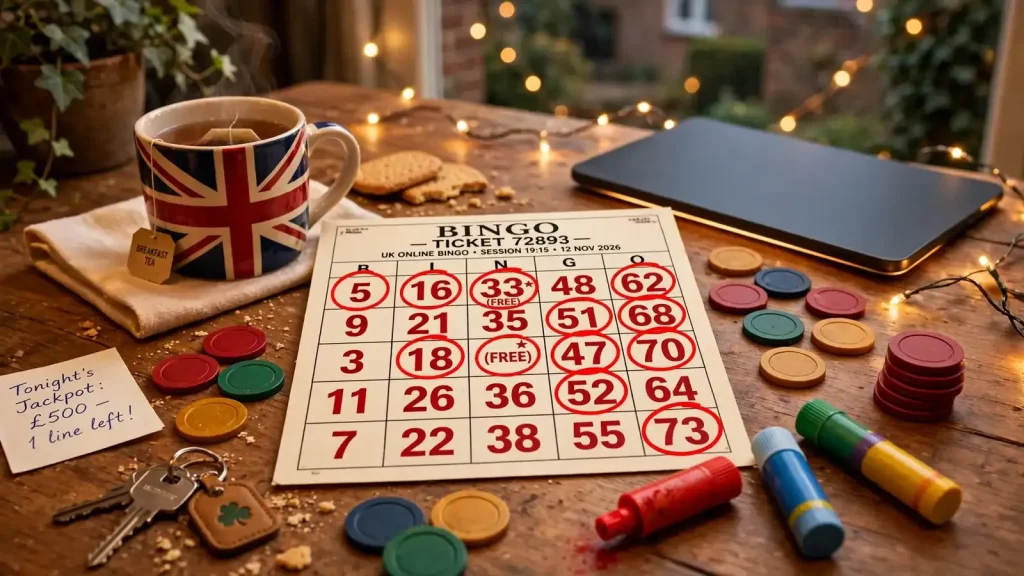
Bingo play centres on matching drawn numbers to a ticket pattern, while site features, promotions and mobile access vary.
How Online Bingo Rooms Work
Online bingo has a simple underlying sequence: you buy a ticket, numbers are drawn, and the ticket wins if it completes the pattern required for that game before other players do. The room supplies the draw and checks the tickets against it. Your task is to understand what the ticket contains and which pattern counts as a win; the details vary by bingo format.
A ticket is a grid containing numbers and spaces. As numbers are drawn, matching numbers on your ticket are marked. The marks accumulate over the course of the game, so a ticket that has not yet completed the required pattern may still be in contention. A win is not determined by how many numbers you have marked in isolation. It depends on whether those marks form the pattern set for the game, and whether another ticket completes it first.
This shared mechanism applies whether you join an online bingo room on a website or through an online bingo casino app. The interface may show the draw, your ticket and any called numbers together, but the underlying process remains the same. The product is a number draw matched against tickets, not a separate kind of casino game simply because bingo is offered alongside other games.
When choosing an online bingo option in the UK for 2026, payout timing is one practical detail to check. Use these verdicts as a quick reference for the payout speed stated for each operator.
-
SlotoSport
- Payout speed
- 1-3 business days
SlotoSport lists a payout speed of 1–3 business days, giving you a stated timeframe to consider.
-
SpinFormula
- Payout speed
- 1-3 business days
SpinFormula lists a payout speed of 1–3 business days. This gives you a clear stated timeframe when reviewing it.
-
Chanze
- Payout speed
- 1-3 business days
Chanze’s stated payout speed is 1–3 business days, a practical detail for you to keep in mind.
-
NightLuck
- Payout speed
- 1-3 business days
NightLuck lists payouts as taking 1–3 business days. You can use that stated timeframe as one point of reference.
-
Zombillion
- Payout speed
- 1-3 business days
Zombillion has a stated payout speed of 1–3 business days, which gives you a timeframe to consider.
-
NightWin
- Payout speed
- 1-3 business days
NightWin lists a payout speed of 1–3 business days. That is the available timing detail for you to note.
-
Revery Play
- Payout speed
- 1-3 business days
Revery Play’s stated payout speed is 1–3 business days, offering you a clear timing reference.
-
Jetsetspins
- Payout speed
- 1-3 business days
Jetsetspins lists payouts as taking 1–3 business days, a useful stated detail for your review.
-
EvoSpin
- Payout speed
- 1-3 business days
EvoSpin gives a payout speed of 1–3 business days, providing you with a stated timeframe.
-
Britsino
- Payout speed
- 1-3 business days
Britsino lists a payout speed of 1–3 business days, which you can factor into your review.
90-ball bingo
In 90-ball bingo, the ticket has three rows and nine columns. Each row can be completed as a line, while completing all the required numbers on the ticket makes a full house. The game can therefore award a prize for one line, two lines, or a full house.
These are separate milestones within the same game. If your ticket completes one line, that does not mean the whole game has ended: the draw can continue towards the next required result. A ticket that has already achieved one milestone may remain relevant as numbers are called. To follow the game, check which result the room is currently awarding and whether your marks satisfy that condition.
The format also makes clear why “having several marked numbers” is not enough to establish a win. The marks must complete a row or the full-house requirement. If they are scattered across the ticket without forming the relevant result, the ticket has not reached that milestone.
80-ball bingo
An 80-ball ticket uses an eight-column, four-row grid. Rather than relying on the line-and-full-house sequence used in 90-ball bingo, games can use coloured patterns. Possible targets include the four corners, a letter shape, or a full card.
The pattern is the rule that connects the ticket to the win. For a corners game, for instance, the relevant marks must occupy the four corner positions; a collection of marks elsewhere does not meet that target. A letter-shaped pattern works in the same way: the marks need to trace the designated shape on the grid. The room’s displayed pattern tells you what to look for before and during the draw.
 Online Casino American Roulette in the UK: RulesLearn how the 0 and 00 affect American roulette, read the table layout and compare bet payouts. The stated winning chance is…
 Monopoly Live Casino UK: Format, Odds and ChecksLearn how live-dealer streams differ from game rules, what roulette odds and stats can show, and what to verify in a casino’s…
A full-card target requires the ticket to complete the specified card pattern rather than a partial shape. This distinction matters when comparing games within the same format: the grid can remain the same while the winning condition changes. Read the target shown for the individual game instead of assuming that every 80-ball room uses the same pattern.
75-ball bingo
In 75-ball bingo, the ticket is arranged as a five-by-five grid. The game is based on completing a pattern within that grid. Depending on the game, the target might be a cross, an X, a diamond, a letter T, or a picture frame.
Here, the shape of the marked spaces is central. Numbers may be called and marked without bringing the ticket close to the required pattern if they fall in unrelated positions. Conversely, a pattern can take shape as the relevant positions are marked. The game’s target gives you the test: compare your marked ticket with the displayed shape, rather than counting marks without regard to where they sit.
The pattern-based approach separates 75-ball play from the line milestones of 90-ball bingo. It also means that two 75-ball games can require different results even though both use the same size grid. The format identifies the ticket structure; the game’s stated pattern identifies what you need to complete.
90-ball bingo
A three-row, nine-column grid where wins are based on completing one line, two lines, or a full house.
80-ball bingo
An eight-column, four-row grid using coloured patterns such as four corners, letter shapes, or a full card.
75-ball bingo
A five-by-five grid where winning targets include shapes like a cross, an X, a diamond, a letter T, or a picture frame.
What to check before a draw
Before joining any online casino bingo game, identify three things: the ticket layout, the winning condition, and how the room indicates called numbers and completed results. Those details let you tell whether a game is based on lines, a full house, or a particular shape. They also prevent confusion when several formats appear in the same bingo area.
In the United Kingdom, online bingo is legal when offered by an operator holding the required UK Gambling Commission licence. The licence framework includes requirements relating to fairness, anti-money laundering and responsible gambling. That regulatory context does not change how a ticket works: the game still turns on the draw and the pattern stated for that room.
What Changes When You Play Bingo and Slots Together
When bingo and slots appear in the same online service, you are using two different game systems alongside one another. The bingo room runs its own game: you hold a ticket, numbers are drawn, and a win depends on the room’s required pattern. A slot game has a separate play sequence and outcome. Sharing a site or account does not make those outcomes part of the same draw.
That distinction matters when an offer connects the games. A specialist review describes some bingo rooms as awarding a free slot spin for each bingo ticket purchased. In that arrangement, buying a bingo ticket may trigger an additional slot play, but the ticket and spin remain separate. The ticket participates in the bingo game; the spin produces an outcome in the slot game. A slot result does not complete a bingo pattern, and a bingo result does not determine the slot outcome.
 Online Casino Tournaments in the UK: RulesLearn how fixed-spin and timed formats define eligible play, how scoring shapes decisions, and what to check before entering a free-entry or…
 Casino Dice Games in the UK: How Outcomes WorkLearn how random-number outcomes differ from their on-screen animations, plus what to assess across UK-licensed and offshore dice casinos.
The connection is therefore between the activity that qualifies and the extra play that is awarded, not necessarily between the games’ results. If a ticket qualifies for a spin, that does not mean the spin is part of the bingo prize or that its outcome changes the ticket’s status. Likewise, receiving a spin does not establish that the bingo ticket has won. Treat the two results as separate unless the promotion’s wording explicitly explains a different arrangement.
This is useful when you see bingo and slot games presented together on one page. The shared interface may make them look like a single product, but the important question is what action belongs to which game. A bingo ticket is used in the room’s draw. A slot spin is used in the slot game. Any extra link between them depends on the offer attached to the room or game, rather than on a general rule that applies to all bingo and slots online.
A linked spin is still slot play
A free spin can make slot play visible within a bingo experience, but it does not turn the slot into a bingo round. The spin has its own result and belongs to the slot game. The ticket remains subject to the bingo room’s rules and result. Keeping that separation in mind helps you read an offer accurately: purchasing a ticket may be the condition for receiving an additional game, without making the additional game part of the ticket itself.
The word “free” also describes how the spin is awarded, not what its outcome will be. It does not, by itself, tell you whether a win can be withdrawn, whether further conditions apply, or how the spin is selected. Those details depend on the offer’s terms. You should not infer them simply from the fact that a spin is linked to a ticket purchase.
The same principle applies in reverse. A slot game may sit beside a bingo room, but its presence does not mean that every bingo ticket includes slot play. The reported ticket-to-spin arrangement is an example of how a site can connect the two activities, not a feature to assume whenever you find bingo and slots on one service.
Compare the games on their own terms
A further difference is how a game describes its expected returns. A specialist review reports that side games can have lower return-to-player percentages than the bingo room itself. This is a reported comparison, not a rule that applies to every room or slot. It also does not predict the result of an individual session: a percentage describes a game-level measure, not what a particular player will receive on a particular play.
For that reason, do not treat the presence of slots as evidence that they offer the same return profile as the bingo room. Nor should you assume that a free spin is equivalent to a bingo ticket: they belong to different games and may be evaluated differently. If a site presents both, assess each game according to its own information and keep any promotion’s conditions distinct from the underlying game rules.
 European Roulette at UK Online Casinos: Rules and BetsLearn how European roulette works on a 37-pocket wheel, how bets and payouts differ, and what to check when comparing RNG and…
 Live Baccarat Online Casinos in the UK: What to CheckLearn how to assess a UK casino’s live baccarat setup, from checking its UK Gambling Commission licence to reviewing table information and…
Playing online bingo and slots together can therefore mean little more than having access to both within one service, or it can include a specific promotional link such as a slot spin awarded after a ticket purchase. In either case, the core distinction remains: bingo outcomes come from the room’s draw and pattern, while slot outcomes come from slot play. Knowing which action produces which result makes it easier to understand what you are taking part in without assuming that one game controls the other.
How to Assess Bingo Sites That Also Offer Slots
A site can present bingo rooms and slot games under one account, but that combination does not establish that it is authorised to offer either activity to UK players. The first check is the operator’s UKGC licence number. A business serving the British market must hold the relevant licence from the UK Gambling Commission; a foreign address or a familiar-looking brand does not replace that requirement.
Look for the UKGC licence number prominently displayed in the site footer. If it is not there, close the tab. Do not treat a logo, a statement that the site is “regulated”, or a link to a general gambling policy as a substitute for the number. Before depositing, check that number against the UKGC public register. The register check is a separate step: a number printed on a site is a claim, while the regulator’s register is where you verify the authorisation.
Check what the licence is attached to
A group may operate several brands, and the name shown on a bingo page may differ from the legal name of the licensed business. When you look up the number, check the registered operator details rather than assuming that a brand name alone confirms the licence. The relevant question is whether the business responsible for the gambling service is authorised to serve UK customers.
This matters for online bingo sites with slots because the shared website can make distinct products look like one undifferentiated service. The presence of a bingo lobby does not itself prove that the operator is authorised, and the presence of slot games does not add authorisation. Both are part of a real-money gambling service; the operator’s UKGC status is the starting point for assessing the site.
A licence is also not a quality ranking. It does not tell you that one site has better games, a more generous offer, or a more suitable interface than another. It indicates that the operator is subject to the UKGC’s requirements. Treat authorisation as a necessary threshold, not as evidence that every feature or commercial term will suit you.

Understand the standards behind the authorisation
UKGC licence requirements cover fairness, anti-money laundering and responsible gambling. These are operational obligations, not decorative statements for a footer. Fairness concerns the way gambling products are run; anti-money laundering requirements govern how operators address financial crime risks; and responsible-gambling standards concern the operator’s responsibilities around gambling-related harm.
When assessing a site, look for clear information about who operates it and how to contact the business, alongside its licence details and policies. Then consider whether the information is consistent across the site. If the footer names one operator but the terms identify another, do not guess which business is responsible: return to the register and establish what the licence covers before proceeding.
The licence does not remove the need to read the site’s own rules. It sets the regulatory framework; the operator’s terms explain how its services work in practice. Keep those questions distinct. First establish that the operator is authorised. Then assess the particular service and its conditions. This avoids mistaking a polished design, a large game catalogue or a claim of “fair play” for proof of regulatory status.
Use a simple decision sequence
For a new bingo-and-slots site, check the footer for the UKGC licence number, verify it on the Commission’s public register, and confirm that the listed operator is the business behind the service. If the number is absent or the register check does not establish the relevant authorisation, do not proceed on the strength of the site’s own claims.
Verifying a Site
-
1
Locate the number
Find the UKGC licence number displayed in the website footer.
-
2
Check the register
Verify the number against the official UKGC public register.
-
3
Confirm the operator
Ensure the registered operator details match the business responsible for the service.
Apply the same test whether you are considering an established platform, a newly launched brand or a site you intend to use on mobile. A different screen or brand presentation does not change the licensing requirement. Once the authorisation is confirmed, evaluate the site’s terms separately; the licence is the foundation for due diligence, not a recommendation to play.
Ticket Prices, Prizes and Real-Money Play
A bingo ticket is the amount you stake on a game. Online rooms set different prices for different games, so the cost of joining is not fixed across a site. Lower-stakes rooms may offer tickets priced from 1p to 5p; some are described as penny rooms, with tickets starting at 2p. At the other end, premium games can charge £1 or more per ticket, and high-stakes rooms may list prices of £5 or above. The price shown for the game you select is the amount at stake for each ticket, not a general fee for using the room.
That distinction matters when deciding how much to spend. If you buy several tickets, the total stake rises with the number purchased, even when each ticket costs only a small amount. Before confirming, check the price per ticket and the quantity in your basket. A low individual price does not by itself tell you the total cost of taking part.
The prize can also vary with the game and its stake. A specialist review gives an illustration in which a 1p game has a £10 full-house prize, whereas a £1 game is associated with a jackpot reaching into the hundreds or thousands. Treat this as a reported comparison, not a promise or a standard relationship between ticket price and prize. The prize available in a particular room depends on that game’s stated terms; a higher ticket price does not, on its own, tell you what you will win.

Look at the prize information before buying. The displayed prize may be tied to a specific outcome, such as a full house, rather than paid for any win. The amount and the condition for claiming it are separate details: the ticket price tells you what you commit to spend, while the game’s prize rules state what event qualifies for a payout. If the prize depends on how many people enter or tickets are sold, the room should explain that mechanism in its game information. Do not infer a fixed payout from the ticket price alone.
For real-money bingo, it is useful to separate the stake, the possible prize and the result. The stake is the cost of entering; the prize is conditional on meeting the game’s winning requirement; and neither makes a return certain. Buying more tickets increases the amount spent, but it does not turn a listed prize into a guaranteed outcome. The same distinction applies when you encounter bingo and slots in one online casino: they are separate forms of play, and a bingo ticket’s price should not be mistaken for a slot-game stake or a combined price.
If you are comparing rooms, compare like with like. Check the ticket cost for the same type of game, then read what the advertised prize applies to. A small-stake game with a clearly stated prize may suit a different budget from a premium game with a larger advertised jackpot. Neither figure alone describes the value of a game: you need both the cost of entering and the conditions attached to its prize.
Do
- Check the price per ticket and quantity in your basket
- Review the specific conditions for claiming a prize
- Calculate your total outlay before joining a game
Don't
- Assume a low ticket price means a low total cost
- Infer a fixed payout from the ticket price alone
- Mistake a bingo ticket price for a slot-game stake
For recreational players in the United Kingdom, online bingo winnings are not taxable. That concerns tax treatment of winnings; it does not change the amount you stake or make any prize certain. When you decide what to spend, use the ticket price and quantity to calculate your outlay before joining, and treat any potential payout as an uncertain outcome rather than money already earned.
Free Bingo Tickets and Slot Promotions: Check the Conditions
A ticket described as free may still come with conditions that affect when you can use it, where it is valid and what happens to any winnings. Read the promotion’s terms before accepting it: the label tells you that you are not paying for the ticket, but it does not establish that winnings can be withdrawn straight away.
Check which room and ball type the ticket covers. A free ticket may be limited to a particular room or format, so it might not work in the game you intended to join. Expiry is another restriction. A specialist review reports that one offer’s tickets can expire after 24 hours; another specialist review gives an expiry range of 24 to 72 hours. These are reported offer terms, not a guarantee about every promotion. Look for the expiry time attached to the specific ticket and use it before that point.

What happens to ticket winnings
Free tickets cannot be withdrawn as cash. If one wins, the winnings are credited to your account, and a wagering requirement may apply before you can withdraw them. In other words, the important distinction is between winning cash in the account and having withdrawable cash: the promotion’s conditions can separate those stages.
A specialist review reports wagering requirements for free-ticket winnings in the range of 20x to 65x. Treat that as a report about offers, not a standard that every operator follows. The individual terms should state whether the requirement applies to winnings from the ticket and how qualifying play is counted. If the explanation is unclear, do not assume that a win is available for withdrawal simply because it appears as a cash balance.
Ticket offers are not deposit bonuses
A free-ticket promotion and a deposit bonus work differently. A ticket offer gives you a ticket subject to its room, format and expiry conditions. A deposit bonus is linked to money you deposit and may carry its own wagering requirement. The conditions for a deposit offer do not automatically tell you how a ticket promotion works, or vice versa.
Some promotions may connect ticket winnings to the wagering requirement used for a deposit bonus. That possibility makes it important to check whether accepting one offer also places winnings under another offer’s rules. Read the terms for the exact promotion you are claiming, including any section that explains withdrawal eligibility.
The same caution applies when an offer mentions online bingo and slot play together. A promotion’s name does not tell you which funds or winnings are covered, or what conditions apply to them. Check the written terms for each component rather than assuming that free play means unrestricted cash. Before you opt in, identify the eligible game, the expiry condition, the wagering requirement and the point at which winnings become withdrawable.
Bingo Formats and Player-Safety Controls
The grid determines what you need to complete, while the pace of a round depends partly on the format. In 75-ball bingo, the ticket has a 5×5 grid and a win is based on completing a specified pattern. That could be a cross, an X, a diamond, a letter T or a picture frame. The target is therefore a shape across the grid, rather than simply a row of completed numbers.
80-ball bingo also uses a pattern-based card, but its 4×4 grid supports quicker rounds than 90-ball bingo. The smaller layout means the action can move faster; it does not change the need to follow the pattern that applies to that game. Before joining, check which format and winning pattern the room is using so you know what counts as completion.
Game format is separate from account safeguards. In Great Britain, gambling is for people aged 18 and over, and an operator must verify your age before allowing you to deposit. A UK-licensed operator must also verify your identity; this can involve providing photo identification and proof of address. These checks are part of account access, not something that depends on whether you choose bingo or slots.

Financial controls help you set a boundary on deposits. A specialist review describes operators as offering deposit limits for a day, a week or a month. Remote operators must also prompt new customers to set a financial limit before their first deposit and make account-level limit controls accessible. Check the account settings to see how to set or change a limit, and choose an amount that fits your budget before playing.
Self-exclusion is another control offered by UK-licensed casinos. It can restrict access to gambling, rather than merely setting a spending boundary. If you use bingo and slot games within one account, consider how your limits and any exclusion apply across the account, rather than assuming each game has a separate allowance. The purpose of these controls is to make spending and access limits explicit; they do not alter how a bingo pattern is completed.
When and Where to Join a Bingo Game
A bingo room’s schedule determines when a game is available; its ticket limit determines how many entries you can buy once you join. Check the room’s listing before selecting tickets: a game may be open for sales, waiting for its draw, or already closed to new entries. Joining after sales close means waiting for another game in that room.
Peak playing times
Between 7pm and 11pm, operators often schedule their largest prize pools due to peak bingo-room traffic.
Ticket caps apply to each game, not necessarily to your account across every room. Most rooms set a maximum number of tickets per player for a single game. The cap is commonly reported as falling between 10 and 50, with the permitted amount varying according to ticket price. The room’s displayed limit is the one that matters for the game you are considering. If you want more entries than it allows, you cannot simply add them to that same game; you would need to choose another available game or wait for the next one.
Timing can also affect the size of the available prize pool. A specialist review identifies 7pm to 11pm as a peak period for bingo-room traffic and says operators schedule their largest prize pools during those hours. Treat that as a reported scheduling pattern, not a promise that every room will have its largest game then. Room calendars and game listings show what is actually scheduled, so check those rather than relying on the time alone.
A practical way to decide when to play is to compare the game’s start time, ticket cap and displayed prize information before buying. A busier period may offer larger scheduled pools, but it can also mean more players are taking part. The room’s own listing tells you whether the game is still open and how many tickets you can select; the schedule tells you when another opportunity is due.
If you are looking for a place to play bingo alongside slots, first distinguish the scheduled bingo game from any other games shown on the site. A slot game does not reserve a place in a bingo draw. For the bingo game itself, your entry depends on purchasing tickets while sales remain open and staying within that game’s stated cap.
Playing Bingo and Slots on a Mobile Device
Playing bingo and slots on a phone or tablet does not change the rules that govern deposits and access to a gambling account. The operator must check that you are old enough before it allows you to deposit. In the UK, online gambling is for people aged 18 and over, and a licensed operator must verify your age before funds can be added.
That check is a condition of depositing, not a rule that applies only when you use a particular device. If you are asked to complete age verification, you may need to do so before making a deposit, even if you can already access the site or view its games. Do not treat access to a game as confirmation that every account check is complete.
Payment choice is also restricted. Credit card gambling has been banned in Great Britain since April 2020. A debit card or another permitted payment method may be used instead, subject to the operator’s payment rules. A digital wallet is not automatically an alternative: operators cannot accept wallet payments for gambling if the wallet allows credit-card funds to be used. The important distinction is the source of the funds, not simply whether payment is made through a card, wallet or another service.
Before you deposit from a mobile device, check which payment methods the operator accepts and whether the one you intend to use is eligible for gambling transactions. If a credit card is involved, do not try to route the payment through another service to get around the ban; remote operators cannot accept credit-card-funded gambling payments through a money service business either.
- Confirm you are aged 18 or over
- Complete the operator's age verification process
- Ensure your payment method is a debit card or other permitted route
- Verify that your payment source does not involve a credit card
The same checks and payment restrictions apply whether you are using a bingo room, a slot game or both. A mobile connection does not make a prohibited payment acceptable or remove the age-verification requirement. Keep those two conditions separate: you must meet the age check before depositing, and the money used for gambling must come through an allowed payment route.
What a Bingo Slot Machine Is—and Is Not
A bingo-themed slot may use bingo cards, numbered balls or familiar room imagery, but its name and appearance do not make it a bingo room. In a room, you buy a ticket for a shared draw, and the result depends on whether its numbers complete the required pattern. A slot instead runs as an individual game: you start a spin and the game determines its outcome. There is no room-wide number draw in which your ticket competes to complete a pattern.
That difference matters when you compare the return figures shown for games. A slot’s return-to-player (RTP) figure describes its theoretical long-run payout, not what you will receive from a particular session. Side games can have a lower RTP than the bingo room they sit alongside, so check the information for the specific game rather than assuming the room’s figures apply to it.

Online slots in Britain also have play limits. A spin must take at least 2.5 seconds, and autoplay is banned. The maximum stake per game cycle is £5 for customers aged 25 and over. For customers aged 18 to 24, the maximum is £2. The £5 limit for all adults took effect on 9 April 2025; the lower limit for younger adults remains relevant.
These rules concern slot play, including a slot with bingo-themed graphics. They do not turn that game into a bingo room or change how a bingo ticket wins. When you select a game, identify whether you are entering a shared bingo draw or starting a slot spin; the display may look familiar, but the mechanism and applicable limits differ.
Can You Play Slots at an Online Bingo Site?
Yes. Some online bingo rooms also provide access to slot games, so a bingo account may let you take part in both types of play. Availability depends on the site and its game offering; a bingo room does not automatically include slots.

Keep the two activities separate when you play. A bingo ticket enters you into a room’s number-draw game, where the result depends on completing the required pattern. A slot game is a separate game, with its own stake and outcome. Buying a bingo ticket does not turn a slot spin into a bingo entry, or make a slot result count towards a room’s prize.
A specialist review has described rooms where buying a bingo ticket can be linked to a free slot spin. Treat that as a specific offer, not a standard feature of every bingo site. The slot remains separate from the bingo game even when access to a spin is connected to a ticket purchase.
Slot play at a UK bingo site is subject to Britain’s online slot rules. Autoplay is banned, and each online slot spin must last at least 2.5 seconds. The maximum stake per game cycle is £5 for players aged 25 and over, and £2 for those aged 18 to 24. These limits apply to slot play, not to the mechanics of a bingo room.
So, check whether the site actually offers slots and distinguish them from its bingo rooms. If a slot is available, its play follows the rules for online slots; the presence of bingo tickets does not change those constraints.
Are online bingo winnings taxable in the UK?
No, winnings from online bingo are not taxable for recreational players in the UK.
How do I know if an online bingo site is safe?
Check that the operator holds a UK Gambling Commission licence. Licensed operators must meet requirements covering fairness, anti-money laundering and responsible gambling.
What is the best payment method for online bingo in the UK?
E-wallets are one option: withdrawals typically process within 24 hours after the operator releases the funds. Credit cards cannot be used for gambling in Great Britain; use a debit card or an alternative payment method.
Are the promoted bingo sites licensed by the UK Gambling Commission?
A site must hold a UK Gambling Commission licence to legally offer online bingo to UK players. Check for the operator’s licence before playing.
Casino Games: UK Slots, Live Casino and More
Content created by the «goodthingsshare» team