
Understand the mechanics before choosing a progressive slot
 Available in US

Progressive jackpots draw small contributions from connected wagers, while triggers, RTP and payout terms vary by game.
How Progressive Jackpot Pools Build
A progressive jackpot is funded incrementally by wagers on connected versions of a slot. Rather than keeping the whole wager within the individual game’s ordinary payout structure, the game directs a portion into a jackpot pool. As more qualifying wagers are placed across the connected game, those contributions accumulate in the shared balance.
The contribution is small relative to the full stake: progressive jackpot slots typically allocate between 1% and 3% of each wager to the pool. The exact amount depends on the game. This means the pool grows through many contributions, not through a separate payment made by a player when a jackpot is won. You do not need to be the only person playing the game for the balance to increase; wagers on other connected machines can add to it as well.
The process can be understood as two linked flows. A wager enters the game, and the game allocates part of it to the progressive pool while the rest remains within the game’s other payout arrangements. The pool receives contributions from connected slot machines, so its displayed balance reflects activity beyond the individual session in front of you. The precise contribution rule belongs to the particular game, but the underlying idea is that a portion of wagers builds a prize shared across its network.
When exploring progressive slots online in the UK in 2026, payout timing is one practical detail to check. Use this list as a reference for the stated withdrawal speed at each operator.
-
SlotoSport
- Payout speed
- 1-3 business days
You can expect payouts to take 1–3 business days.
-
SpinFormula
- Payout speed
- 1-3 business days
You can expect payouts to take 1–3 business days.
-
Chanze
- Payout speed
- 1-3 business days
You can expect payouts to take 1–3 business days.
-
NightLuck
- Payout speed
- 1-3 business days
You can expect payouts to take 1–3 business days.
-
Zombillion
- Payout speed
- 1-3 business days
You can expect payouts to take 1–3 business days.
-
NightWin
- Payout speed
- 1-3 business days
You can expect payouts to take 1–3 business days.
-
Revery Play
- Payout speed
- 1-3 business days
You can expect payouts to take 1–3 business days.
-
Jetsetspins
- Payout speed
- 1-3 business days
You can expect payouts to take 1–3 business days.
-
EvoSpin
- Payout speed
- 1-3 business days
You can expect payouts to take 1–3 business days.
-
Britsino
- Payout speed
- 1-3 business days
You can expect payouts to take 1–3 business days.
“Connected” matters because it defines which wagers feed a particular jackpot. A progressive slot may be available through more than one operator, with those operators carrying the same networked game. When they do, the jackpot pool can be shared across them. A wager on one operator’s version can therefore contribute to the same pool as a wager on the game offered elsewhere. The participating operators are not each building an unrelated copy of that network jackpot; the shared pool links play across the connected versions.
This is why the operator’s website is not necessarily the boundary of a progressive jackpot. A game can appear in separate casino catalogues while remaining connected to one underlying jackpot network. The relevant connection is between the versions of the same progressive slot, not simply between all games offered by a particular operator. Playing another title from the same provider does not, on that fact alone, mean that your wager contributes to this pool. The contribution follows the connected game.
You can picture the pool as a running total fed by small slices of wagers across that network. Each contribution adds to the total, and activity from multiple operators can accumulate in the same balance when they carry the same progressive slot. This explains how a jackpot can grow beyond what could be funded by play on one screen or at one casino alone. It also explains why the balance is associated with the game’s network rather than solely with the account through which you happen to access it.
 Slots: UK Casino Providers and Game CategoriesExplore UK casino slot categories by game provider and theme, from jackpot and bingo options to Android casinos and online game shows.
 Penny Slot Machines in the UK: Stakes and RTPLearn how to calculate a penny slot’s total spin cost, compare limits and RTP, and why a practical UK definition sets the…
The displayed jackpot figure represents the accumulated pool, but it does not tell you how much any one player has contributed. Nor does the growth of the balance mean that each individual wager has a large effect on it. Since only a portion of a wager is directed to the pool, the total builds from contributions made across connected play. The amount contributed by your wager is therefore only one part of a larger stream.
When comparing online slots with progressive jackpots, keep the funding mechanism separate from the game’s presentation. A large displayed prize does not mean that the full stake is being added to it, and the word “progressive” does not mean that every slot on the same site feeds one common balance. The pool is tied to the specific progressive game and its connected machines. A video slot, for instance, contributes to a shared jackpot only where that game is part of the relevant network.
This also clarifies what “shared” means in a UK context. It describes how wagers on connected instances of the same game can build a common pool across operators carrying it. It does not mean that all progressive jackpot slots sites in the market are linked to one another, or that a jackpot balance transfers between unrelated titles. Each network pool has its own participating game versions and its own stream of contributions.
If you are trying to understand where a jackpot comes from, follow the wager rather than the headline prize. Identify the particular progressive slot, then consider that connected versions may collect contributions into one pool, including versions offered by different operators. The key mechanism is the allocation of a portion of wagers to that game’s shared balance. The size of the balance reflects accumulated network contributions; it is not a separate pot created solely by the operator currently displaying the game.
How Jackpots Trigger—and When Your Stake Matters
A progressive jackpot can be won through different trigger rules, so the word “progressive” does not tell you what must happen during a spin. The game’s rules determine whether the jackpot is tied to a random event, a particular combination or a bonus feature. To understand how to win at progressive slots, you need to identify the condition that the specific game sets.
With a random trigger, the jackpot can be awarded when the game’s random mechanism selects it. A qualifying symbol combination does not necessarily have to appear; the trigger is the random event itself. That does not make the result predictable. The fact that a jackpot is random gives you no way to know when it will land, or to infer from recent spins that it is due.
Other games make the jackpot dependent on a specified combination. In that case, the combination is the condition to look for in the game rules. A different design may award the jackpot through a bonus round: reaching or entering that feature is part of the route to the prize. The details are game-specific, so a bonus round in one slot does not imply the same jackpot process in another.
 UK Online Casino Ratings: Amatic Games and OperatorsUnderstand why an Amatic game does not rate the casino operator, and how UKGC-licensed operators differ from the software suppliers whose games…
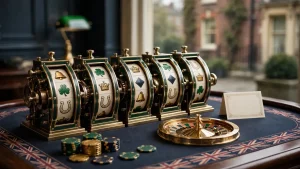 Amatic Slots in UK Casinos: How They WorkLearn how Amatic slots reach casino lobbies, how fixed paylines shape results, and what to check about play, bonuses and account handling.
These distinctions matter when you ask how online progressive slots work. The game may show a growing prize, but the visible amount does not explain how that prize is triggered. Read the game’s paytable or rules for the jackpot condition, including whether the relevant feature is random, combination-based or linked to a bonus round. If the rules are unclear, do not assume that ordinary wins or bonus features qualify for the jackpot.
Stake can affect eligibility in some games, but it is not a universal rule. A specialist review reports that certain randomly triggered progressive slots require a minimum wager for a player to qualify for the highest jackpot tier. That is a claim about some games, not a condition that applies to every progressive slot. Check the rules for the particular game to see whether a stake threshold applies and which prize tier it affects. Meeting a stated threshold would establish eligibility under those rules; it would not guarantee a jackpot.
The phrase “must-hit-by progressive slots UK” may suggest that a jackpot is guaranteed to appear by a stated point. Do not treat that wording alone as proof of a particular trigger or guarantee. The reliable way to determine how a game works is to consult its own rules and identify the event that awards the jackpot. A label or promotional description is not a substitute for that condition.
There is no fixed answer to how often progressive slots hit based only on their trigger type. A random trigger does not give you a schedule, while a combination or bonus-round trigger depends on meeting the game’s stated condition. Neither description tells you when the next jackpot will be won. You can establish the route to a prize from the rules; you cannot use that route to predict the timing of a win.
Do
- Consult the game's own rules or paytable
- Identify the specific jackpot trigger condition
- Verify eligibility and stake thresholds
Don't
- Assume a jackpot is due based on recent spins
- Rely on promotional labels as a substitute for rules
- Assume all bonus features qualify for the jackpot
Where to play slots with progressive features is a separate question from how they award a jackpot. Before playing, confirm that the particular game is available through the operator and check its rules there. The trigger, eligibility conditions and any stake requirement are properties to verify for that game, rather than assumptions to carry over from another slot.
Progressive Slot RTP and the Odds Behind the Jackpot
A progressive slot has two related but distinct measures: the return-to-player rate (RTP) for the base game and the chance of winning its jackpot. RTP describes the proportion of stakes that a game is designed to return over a very large number of plays. It is a long-run measure, not a prediction of what you will get back during a particular session.
For progressive slots, the base-game RTP often falls within the 88%–92% range. The portion of the payout that is not allocated to the base game goes towards the jackpot pool. This helps explain the trade-off: some of the game’s potential return is reserved for a prize that can grow as connected play contributes to it.
That relationship does not tell you the odds of winning the progressive jackpot. RTP combines the expected value of different game outcomes; it does not state how frequently any particular outcome occurs. A game could have a jackpot that is rarely won but carries a large potential prize, while its base-game RTP reflects all the other outcomes as well. You cannot work out the jackpot probability simply by subtracting the RTP from 100%.
 Classic Slots Online in the UK: How They WorkLearn how RNGs select slot outcomes, how reels, lines, holds and nudges work, and what to check before playing classic slots online.
 Pragmatic Play Online Casinos in the UK: Slot GuideLearn how Pragmatic Play slots work, and what to consider about UK licensing, bonus conditions, free play and real-money stakes without relying…
The jackpot’s odds depend on how that specific game awards the prize and on the probabilities assigned to its possible outcomes. A published RTP, by itself, does not provide those details. Nor does a higher jackpot amount show that a win is more likely: prize size and win probability are separate properties.
This distinction matters when comparing progressive slots. A game with a lower base-game RTP is not necessarily one with better jackpot odds, and a larger pool does not mean the next spin is more likely to win it. The RTP describes expected returns across the game’s outcomes, while the jackpot probability concerns one particular result. Treating the two as interchangeable can make a headline figure seem more informative than it is.
If you are assessing a game, look for its stated RTP and any game information that explains how its jackpot is awarded. Use the RTP to understand the base game’s long-run return profile; do not use it as a substitute for jackpot odds. Where the game does not state a jackpot probability, the RTP alone cannot fill that gap. The same applies to a list of progressive slots: names or prize displays do not establish which game offers the best chance of a jackpot.
In practical terms, progressive slots RTP gives you a broad measure of the game’s expected return, not a forecast for your balance and not a measure of how close the jackpot is. Keep those questions separate: one concerns the modelled return across outcomes, the other the probability of a specific jackpot result.
What “Penny Progressive” Means in Practice
“Penny” and “progressive” describe different features of a slot. The first signals a low-denomination format; the second refers to a jackpot that grows as wagers are made on connected machines. Seeing both terms together does not, by itself, tell you how much a spin costs or how the jackpot is funded.
A progressive jackpot pool receives contributions from wagers placed on connected slot machines. Its growth is therefore linked to play across those machines, rather than being explained by the word “penny” in a game’s label. A penny-themed progressive slot can still be part of a shared pool; the label alone does not show which machines contribute or how the pool is connected.
For progressive penny slots online in the UK, check the game’s displayed stake settings and jackpot information separately. A low denomination does not mean every available spin costs a penny: the total stake can depend on the selected coin value, number of lines or other settings shown in the game. Nor does the label guarantee that a particular spin will win, or indicate the size of any prize.
The practical meaning is simple: treat the denomination and the jackpot structure as separate details. The game title may signal a penny-slot format, but the game information is what tells you how to set a stake and whether a progressive pool is involved. “Penny progressive” is a description, not a promise about the outcome of play.
Progressive and Non-Progressive Slots: What Changes
The key difference is whether wagers feed a jackpot pool shared across connected machines. In a progressive slot, a portion of each wager contributes to that pool. The jackpot can therefore grow as play continues, rather than remaining at a fixed amount set within the game.
 Progressive Jackpot Slots: How the Pools WorkLearn how progressive pools grow, how slots can share jackpots and what to check when comparing games. Typically, 1% to 3% of…
 Amatic Games at UK Online Casinos: How Access WorksAmatic is a software supplier, not a casino. Learn how its games reach UK operators and what to check about versions, play…
A non-progressive slot has no shared progressive pool. Its payout structure is contained in the game itself: winning combinations pay according to its paytable, and those payouts do not add to a network jackpot. That makes the distinction about where potential payouts come from, not simply whether a game can produce a large win.
The progressive model also affects the base game’s return. Progressive slots often have a base-game RTP in the 88%–92% range, with some of the payout allocation directed to the jackpot pool instead. The base game and jackpot are therefore connected parts of the same payout model: the jackpot contribution supports the growing prize, while the base game pays for its own outcomes. A non-progressive slot does not divert a share of wagers into this kind of pool.
This does not mean every spin on a progressive slot builds the jackpot by the same visible amount, or that a contribution changes the outcome of an individual spin. It describes how the game allocates wager value across its payout structure. The pool is associated with connected machines running that progressive game; it is separate from the ordinary paytable wins.
When comparing progressive slots with non-progressive slots, check whether the game has a shared jackpot and consider the base-game RTP separately from the jackpot opportunity. Those details describe different parts of the payout model. A jackpot figure alone does not show what the base game returns, while the base-game RTP does not describe the full value of the progressive prize.
Progressive Slots
A portion of each wager feeds a shared jackpot pool that grows as connected play continues.
Non-Progressive Slots
Payouts are contained within the game's own structure and pay according to a fixed paytable.
Finding Progressive Slots Available to UK Players
The progressive slot catalogue you can access is determined by the operator you use. A game appearing at one casino does not establish that it is available at another, even when both offer titles from the same provider. A specialist review reports that availability varies between operators and can change when providers update their catalogues. Treat any list of games as a snapshot, not a permanent inventory.
To check what is available, search the casino’s own game lobby for “progressive” or “jackpot”, then open the game’s information panel. Search labels are not always consistent: a title may be filed under a provider, a jackpot category or its name rather than under a dedicated progressive-slots heading. If a search returns no result, browse the relevant categories or search for a specific title before concluding that the casino does not carry progressive games.
The lobby is the practical reference for the catalogue at that operator. A provider’s wider portfolio can help you identify titles to look for, but it does not show which of those titles the casino has made available to its customers. Providers can revise their catalogues, and operators can change which titles appear in their own lobbies. Check again if a game you remember is missing, or if you are comparing availability at different casinos.
If you want to play a game without wagering real money, check the game listing for a demo or free-play option. Do not assume that every listed title has one, or that a free-play version behaves as a route to a real-money jackpot. The operator’s listing should make clear which mode is being offered. If the mode is unclear, use the casino’s game information or support channel to confirm it before starting.
 Elk Studios Online Casinos in the UK: What to CheckLearn how to check a casino lobby for Elk Studios games, use provider filters and search, and assess whether a result is…
 Pariplay Online Casinos in the UK: What to CheckLearn how to verify whether a UK casino currently offers Pariplay slots, and why provider mentions alone do not confirm access for…
A list labelled “best” or “most popular” does not tell you whether a particular title is available to you. Such labels can reflect an editorial selection or a particular operator’s catalogue, rather than a universal ranking across UK casinos. Availability is the first check; deciding whether a game suits you is a separate assessment.
When comparing operators, keep the comparison narrow: is the title in the current lobby, can you open its information, and is the mode you want available? Avoid relying on old screenshots or copied lists, because catalogue changes can make them inaccurate. If a title disappears, that alone does not show why it was removed; check the current listing rather than inferring a cause.
Availability also does not settle whether a game is worth playing. It only tells you whether the operator currently offers access to it. Before you begin, confirm that you have selected the intended title and mode, and read the information shown in the game and casino account. This helps separate three things that are easy to conflate: a game existing in a provider’s catalogue, an operator carrying it, and that operator making a particular way of playing it available to you.
Assessing Progressive Slot Games Without a Ranked List
A useful assessment starts with the specific game, not a claim that one title is the best. Take *Gladiator: Road to Rome*: the name identifies a game to investigate, but it does not tell you what its jackpot rules are, whether it is progressive at a particular casino, or whether you can play it there now. Those details need to be checked against the game information shown by the operator.
- Confirm the exact title in the casino lobby
- Open the information panel to verify the jackpot feature
- Read the instructions for jackpot access conditions
- Test the game on your intended device for mobile play
Start by confirming the exact title in the casino’s game lobby. Similar names or promotional labels are not enough to establish that you have opened the game you intended to assess. Open its information panel or rules and look for an explicit description of the jackpot feature. Check whether the rules identify a progressive jackpot and explain how it operates. If the game page does not make that clear, do not infer the answer from the title, artwork or search listing.
Next, read the game’s own instructions before deciding whether its format suits you. Focus on what the rules actually explain: the available features, how to access them, and any conditions attached to the jackpot. This is more useful than relying on a short promotional description, which may emphasise the prize while omitting details that affect how the game works. If two sources describe the title differently, treat the operator’s current game information and the in-game rules as the material to check before playing.
A progressive jackpot label does not, by itself, tell you whether a game is a good fit. Separate the jackpot feature from the rest of the experience. Consider whether the rules are understandable, whether the game runs clearly on the device you plan to use, and whether you can find the information you need without guessing. These are practical checks, not a ranking: different players can value different features, and a game that suits one person may not suit another.
For mobile play, open the game on the device you intend to use and inspect the menus, rules and display. Check that you can read the relevant information and reach the controls without difficulty. Do not assume that a title’s availability or presentation is identical across devices or operators; confirm what is actually offered in your account.
 Betsoft Casinos in the UK: Games and ChecksLearn how Betsoft games reach UK casino sites and what to check about play, bonuses and regulation. Operators manage accounts and transactions.
 Online Craps in the UK: Licensing and Casino ChecksLearn how UK Gambling Commission oversight applies and what to check in craps tables, formats, odds and account safeguards before choosing a…
The same care applies if you are looking for free progressive slots. Check whether the casino provides a free-play version of the specific title and whether it includes the feature you want to examine. A free mode can help you understand the interface, but its presence should not be assumed, and the mode’s rules should be read rather than treated as identical to real-money play. If no free version is offered, the game’s rules may still describe its features.
Terms such as “mystery” can appear in descriptions, but the label alone does not explain what happens in a particular game. Look for the title’s own definition and rules. If they do not clarify the feature, you cannot reliably judge it from the label.
Game availability is not fixed across the market. A specialist review reports that progressive titles can differ between operators and may change when providers update their catalogues. So, when assessing *Gladiator: Road to Rome* or another progressive slot, verify its current listing at the operator you use rather than relying on an old catalogue, review or recommendation. That check establishes whether the game is available there; the rules and on-screen information establish what the game offers.
Playing for Real Money: Withdrawals and Jackpot Payouts
A real-money progressive jackpot win does not move straight from the game to your bank account. You first need to follow the operator’s withdrawal process: open the cashier, choose an available payment method and submit a request for the funds. The amount shown as available to withdraw and the status of the request are separate matters. A request can be awaiting processing or checks before it is sent to the payment provider.
Withdrawing Winnings
-
1
Request Funds
Open the cashier, select your payment method, and submit a withdrawal request.
-
2
Complete Verification
Provide any requested documents through the operator's secure channel to allow the payout to proceed.
-
3
Monitor Status
Check your account for the request status and wait for the funds to arrive via your chosen method.
The time it takes to receive the money depends on the method. A specialist review reports indicative timings of one to three working days for debit-card withdrawals, hours for e-wallets, and three to five working days or longer for bank transfers. These are not guaranteed delivery times for every UK account. The operator’s own payment terms and the status displayed on your account are more relevant to a specific request; processing and the provider’s handling can affect when funds arrive.
Large jackpot payouts may involve a different process from an ordinary withdrawal. A specialist review notes that an operator may request additional verification and that a very large prize may be paid in structured instalments over several years. Those possibilities should not be treated as a universal rule: the applicable arrangements depend on the operator and the terms attached to the game or prize.
If a verification request appears, check which documents or details the operator needs and provide them through its stated secure channel. Until checks are complete, a payout may not proceed. For an instalment arrangement, read the payment schedule and conditions carefully so you know how the prize is to be paid, rather than assuming the full amount will arrive as a single transfer.
Keep the withdrawal confirmation and any messages about the request. If the payment takes longer than the operator’s stated processing estimate, contact its support team with the withdrawal reference and ask whether the request is still being reviewed, has been sent to the payment provider, or needs further information. This separates an operator-side delay from one occurring after the payment has been released.

Free Spins and Bonuses: Check the Limits Before You Play
Free spins can let you try a slot without staking your own money on each spin, but “free” describes how the spins are supplied, not what you can withdraw from them. The game, eligibility rules and any winnings limit are set by the offer’s terms. If you are looking for free play on progressive slots, check whether the promotion names the game you want and whether that game is eligible: many offers exclude progressive jackpot slots.
A specialist review reports that winnings from free spins on progressive slots may be capped at £50–£100, and that most free-spin promotions are limited to non-progressive games. Treat those figures as reported offer terms, not a promise that every operator applies the same cap. The relevant promotion rules determine whether a progressive game is excluded and what happens if a spin produces a win above the stated maximum.
Check the game and the winnings limit
Before activating spins, look for the eligible-games list and the maximum winnings clause. If progressive slots are excluded, you cannot assume that a free-spin balance can be used on them simply because they appear in the casino catalogue. If a progressive game is included, check whether the offer limits the amount you can keep from its free spins. A cap on promotional winnings is separate from the jackpot displayed by the game; the offer’s terms explain what the promotion will pay.
Free online access can also mean different things. A demo version lets you try a game without a real-money stake, while promotional free spins are issued under an operator’s offer and may have conditions attached. Neither description, by itself, confirms that the progressive jackpot is available or that a prize from a promotional spin can be withdrawn in full. Read the game and promotion terms together before you start.
No-deposit offers have separate conditions
A no-deposit bonus is promotional credit offered without requiring you to make a deposit first. It is not the same as free spins: the bonus may have its own wagering requirement, eligible games and withdrawal ceiling. A specialist review reports wagering requirements of 40x–60x for no-deposit bonuses and maximum withdrawal caps of £50–£100 on winnings from them. These are reported ranges, not standard terms applying to every offer.
A wagering requirement tells you how much qualifying play must take place before winnings become eligible for withdrawal. The offer should specify which games count and whether different games contribute differently. Do not infer that a stated multiplier applies to every kind of bonus, or that progressive slots count towards it. The promotion’s own rules govern those points.
The withdrawal cap is another distinct condition. Meeting a wagering requirement does not necessarily mean that the full balance can be withdrawn: a cap may limit the amount payable from the offer. Check whether the cap applies to bonus winnings, total winnings or another defined amount, and what happens to any balance above it. If the wording is unclear, ask the operator before opting in rather than assuming the most favourable interpretation.
A quick terms check
Before claiming an offer, confirm:
- which games are eligible, including whether progressive slots are excluded;
- whether free-spin winnings have a maximum cap;
- how the wagering requirement is calculated and which games contribute;
- whether a withdrawal cap applies, and exactly what it covers.
These conditions answer different questions. Game eligibility determines where you can use the promotion; wagering rules determine what play is required; and a cap limits what the offer will pay. Checking each separately helps you distinguish promotional play from an ordinary real-money win without assuming that a free spin carries the same terms as a progressive jackpot.
UK Regulation and Progressive Slots in 2026
The UK Gambling Commission is the regulator for gambling activity across the United Kingdom, including online casinos. Its remit for remote gambling is specifically defined for Great Britain: operators offering remote gambling to consumers there fall within its regulatory scope even when the equipment used to provide the service is located elsewhere. The location of a server or other key equipment does not, by itself, take a service outside that scope.
For commercial gambling in Great Britain, the Commission is the only regulatory body. That role is separate from the licences it grants. As regulator, it oversees the commercial gambling sector; as licensing authority, it issues operating licences to businesses and personal licences to individuals who operate within the sector. An operating licence concerns the business providing gambling, while a personal licence applies to an individual carrying out relevant work.

This distinction matters when you are looking at progressive slots offered online. The Commission does not provide the games or operate the casino. Its role is to regulate gambling activity and license businesses and relevant individuals. A game’s progressive jackpot features do not alter which authority oversees a remote gambling service offered to consumers in Great Britain.
The geographic wording also matters. The equipment’s physical location is not the deciding factor for that remote-gambling scope.
When checking who is responsible for a gambling service, distinguish the regulator from the operator. The Commission sets the regulatory framework and issues licences; the business provides the gambling service to its customers. A personal licence is not the same as an operating licence, and neither describes the mechanics of a particular slot. For progressive slots online in the UK, regulation concerns the gambling activity and the businesses and individuals involved, rather than how a jackpot pool is funded or triggered.
Are progressive jackpot slots worth playing?
They may suit you if you value the chance of a large jackpot, but the base game RTP often falls to 88%–92% as part of the payout goes towards the pool.
Do all UK casinos offer the same progressive jackpot games?
No. Game availability varies by operator and changes as providers update their catalogues. The same progressive slot may be offered by multiple operators and share one network jackpot pool.
What should I look for in a progressive jackpot slot?
Check how the jackpot is triggered, whether a minimum bet is needed to qualify for the highest tier, and how the game’s payout is affected by contributions to the jackpot pool.
How fast are progressive jackpot withdrawals paid out?
Debit card withdrawals typically take 1–3 working days, e-wallets can take hours, and bank transfers often take 3–5 working days or longer. Large jackpots may need extra verification and may be paid in instalments over several years.
How do I check if an online casino is licensed in the UK?
Check whether the operator holds a UK Gambling Commission operating licence. The Commission regulates online gambling offered to consumers in Great Britain.
Slots: UK Casino Providers and Game Categories
Content created by the «goodthingsshare» team